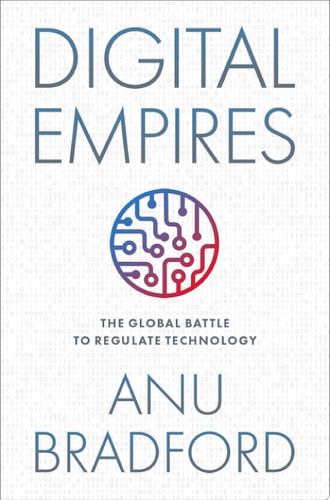
Digital Empires: The Global Battle to Regulate Technology
0
0
As an Amazon Associate and affiliate partner, Menrva Books earns from qualifying purchases. Learn more
Author Description
Financial Times Best Books of 2023 in EconomicsThe global battle among the three dominant digital powers―the United States, China, and the European Union―is intensifying. All three regimes are racing to regulate tech companies, with each advancing a competing vision for the digital economy while attempting to expand its sphere of influence in the digital world. In Digital Empires, her provocative follow-up to The Brussels Effect, Anu Bradford explores a rivalry that will shape the world in the decades to come.Across the globe, people dependent on digital technologies have become increasingly alarmed that their rapid adoption and transformation have ushered in an exceedingly concentrated economy where a few powerful companies control vast economic wealth and political power, undermine data privacy, and widen the gap between economic winners and losers. In response, world leaders are variously embracing the idea of reining in the most dominant tech companies. Bradford examines three competing regulatory approaches―the American market-driven model, the Chinese state-driven model, and the European rights-driven regulatory model―and discusses how governments and tech companies navigate the inevitable conflicts that arise when these regulatory approaches collide in the international domain. Which digital empire will prevail in the contest for global influence remains an open question, yet their contrasting strategies are increasingly clear.Digital societies are at an inflection point. In the midst of these unfolding regulatory battles, governments, tech companies, and digital citizens are making important choices that will shape the future ethos of the digital society. Digital Empires lays bare the choices we face as societies and individuals, explains the forces that shape those choices, and illuminates the immense stakes involved for everyone who uses digital technologies.
Menrva's Summary
THE THESIS
This book investigates how the United States, China, and the European Union are competing to establish the dominant regulatory framework for the global digital economy. Anu Bradford, a professor at Columbia Law School, utilizes her expertise in international law and digital policy to analyze the divergent strategies of these three powers. She argues that the collision between the American market-driven model, the Chinese state-driven model, and the European rights-driven model creates a complex geopolitical landscape that will define the future of digital governance and individual privacy.
THE SCOPE MAP
What You Will Find
- Comparative analysis of the American, Chinese, and European digital regulatory regimes.
- Examination of how tech companies navigate conflicting international legal requirements.
- Discussion of the impact of digital concentration on economic inequality and political power.
- Evaluation of the long-term implications for global digital citizens and societal ethics.
THE AUTHORITY PERSPECTIVE
Experts recognize this work as a critical contribution to the study of digital governance and international political economy. Readers frequently note the clarity with which the author dissects complex regulatory frameworks and their real-world implications for global tech policy.
Page Count:
608
Publication Date:
2023-01-01
Publisher:
Oxford University Press
ISBN-10:
0197649262
ISBN-13:
9780197649268
Science & Technology
Politics
Economics
Sociology
Technology
Laws of Specific jurisdictions
Computer - Internet
Systems Theory
Law
International relations
Technology Law
Specific Topics
History & Culture
Law And Legislation
Community Tags
Similar Books