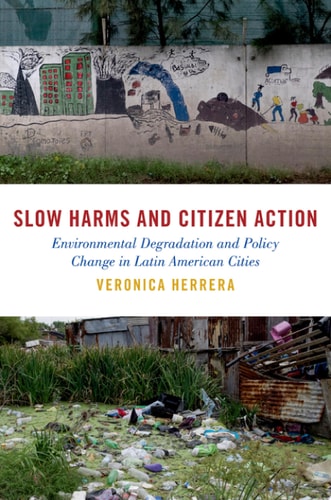
Slow Harms and Citizen Action: Environmental Degradation and Policy Change in Latin American Cities
0
0
As an Amazon Associate and affiliate partner, Menrva Books earns from qualifying purchases. Learn more
Author Description
Environmental degradation is not new, yet the impact of pollution on human health and wellbeing is growing. According to the World Health Organization, 12.6 million people die annually from living or working near toxic pollution, amounting to one-quarter of global deaths. Ninety-two percent of these deaths occur in middle or low-income countries, where the majority of the global population lives. For the millions of communities around the world where pollution is a slow moving, long-standing problem, residents born into toxic exposure often perceive pollution as part of the everyday landscape, particularly in low-resource settings. Local communities may also be both victims of pollution and complicit in perpetrating it themselves. When and how do people mobilize around slow harms? Moreover, when does citizen action around slow harms unlock policy action?In Slow Harms and Citizen Action, Veronica Herrera chronicles the struggle against toxic exposure in urban Latin America. Comparing advocacy movements for river pollution remediation in the capital regions of Argentina, Colombia, and Peru, Herrera explains how citizen-led efforts helped create environmental governance through networks that included impacted communities (bonding mobilization) and resourced allies (bridging mobilization). Through bonding and bridging mobilization, citizen advocacy for slow harms activated the state's regulatory capacity. Moreover, Herrera illustrates how the most successful environmental movements occurred in settings where established human rights movements had previously helped dismantle state-sponsored militarized violence. By unpacking human rights movements as thoroughfares for environmental activism, Slow Harms and Citizen Action sheds new light on the struggles for environmental justice in Latin America.
Menrva's Summary
THE THESIS
This book investigates the conditions under which local communities mobilize to address chronic, slow-moving environmental pollution and how such activism successfully triggers state-level policy changes. Veronica Maria Sol Herrera, a scholar specializing in environmental politics, utilizes a comparative framework to analyze the intersection of citizen advocacy and regulatory governance. By examining the specific socio-political landscapes of Argentina, Colombia, and Peru, the author argues that the success of environmental movements is deeply contingent upon the presence of pre-existing human rights networks and the strategic use of both bonding and bridging mobilization tactics.
THE SCOPE MAP
What You Will Find
- Comparative analysis of river pollution remediation efforts in the capital regions of Argentina, Colombia, and Peru.
- A theoretical framework defining 'bonding mobilization' within impacted communities and 'bridging mobilization' involving external, resourced allies.
- Qualitative evidence derived from field research and case studies of urban environmental activism.
- An examination of how historical human rights movements serve as foundational infrastructure for contemporary environmental justice advocacy.
THE AUTHORITY PERSPECTIVE
Experts identify this work as a significant contribution to the study of environmental governance in the Global South, particularly for its focus on the long-term, incremental nature of toxic exposure. Readers frequently note the academic rigor of the comparative methodology and the clarity with which the author links historical political violence to modern environmental policy outcomes.
Page Count:
280
Publication Date:
2024-01-01
Publisher:
Oxford University Press
ISBN-10:
0197669026
ISBN-13:
9780197669020
Sociology
Public Policy
Community Tags
Other Editions(2)
Similar Books
Reader Comments
Share Your Thoughts
No comments yet. Be the first to share your thoughts!