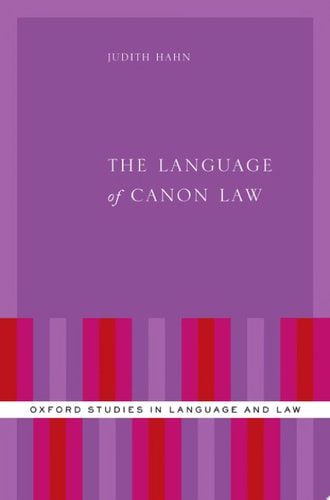
The Language of Canon Law
0
0
As an Amazon Associate and affiliate partner, Menrva Books earns from qualifying purchases. Learn more
Author Description
The Roman Catholic Church has been criticized for many reasons, including its legalism. The growing aversion of church members to the law and the church hierarchy's juridified interpretation of Christianity is fueled by the language of ecclesiastical law (medieval legal Latin), which excludes most of the faithful from understanding and participating in debates on reforming the church's legal structure.In The Language of Canon Law, Judith Hahn explores the legal order of the Roman Catholic Church to better understand how the Roman Catholic Church communicates as a legal institution. She argues that the language of canon law reveals the political ideology of the church hierarchy, and she takes up the tools of language and law scholarship to examine and challenge that language. Examining the function of canon law language in ecclesiastical communications, she studies the character of canonical language, the grammar and terminology of canon law, and how canon law language makes use of linguistic tricks and techniques to create its typical sound. Further, Hahn discusses the comprehension difficulties that arise out of ambiguities in the law, out of transfer problems between legal and common language, and out of canon law's confusing mix of legal, doctrinal, and moral norms.An important contribution to law, language, theology, and sociology alike, this book proposes a rethinking of whether Latin is the appropriate language of a global and cross-cultural legal order like canon law, suggesting that the global church instead seek to develop a multi-language practice.
Menrva's Summary
THE THESIS
This book investigates how the specific linguistic structure and terminology of Roman Catholic canon law function as a mechanism of power and exclusion within the church. Judith Hahn, a scholar of law and language, examines the intersection of medieval legal Latin and modern ecclesiastical administration. She argues that the current reliance on specialized canonical language serves to reinforce the political ideology of the church hierarchy while simultaneously alienating the laity from participating in institutional reform.
THE SCOPE MAP
What You Will Find
- An analysis of the grammar, terminology, and rhetorical techniques inherent in ecclesiastical legal documents.
- A critique of the use of medieval legal Latin within a contemporary, global, and cross-cultural religious institution.
- Case studies examining the comprehension barriers created by the blending of legal, doctrinal, and moral norms.
- A proposal for transitioning toward a multi-language practice to improve transparency and inclusivity in church governance.
THE AUTHORITY PERSPECTIVE
Scholars in the fields of law, theology, and sociology recognize this work as a significant contribution to the study of institutional communication and legal reform. Readers frequently note the academic density of the prose, which provides a rigorous examination of how linguistic choices shape the power dynamics of religious organizations.
Page Count:
240
Publication Date:
2023-01-24
Publisher:
Oxford University Press
ISBN-10:
0197674240
ISBN-13:
9780197674246
Canon law
Systems Theory
Sociology
Linguistics
Church Leadership
Professional Career & Trade
Theology
New Used & Rental Textbooks
Law
Community Tags
Other Editions(3)

Similar Books