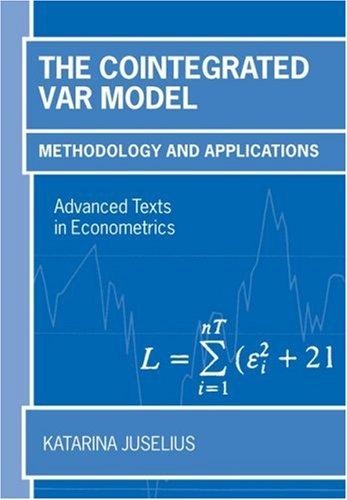
The Cointegrated VAR Model
0
0
As an Amazon Associate and affiliate partner, Menrva Books earns from qualifying purchases. Learn more
Author Description
This valuable text provides a comprehensive introduction to VAR modelling and how it can be applied. In particular, the author focuses on the properties of the Cointegrated VAR model and its implications for macroeconomic inference when data are non-stationary. The text provides a number of insights into the links between statistical econometric modelling and economic theory and gives a thorough treatment of identification of the long-run and short-run structure as well as of thecommon stochastic trends and the impulse response functions, providing in each case illustrations of applicability.This book presents the main ingredients of the Copenhagen School of Time-Series Econometrics in a transparent and coherent framework. The distinguishing feature of this school is that econometric theory and applications have been developed in close cooperation. The guiding principle is that good econometric work should take econometrics, institutions, and economics seriously. The author uses a single data set throughout most of the book to guide the reader through the econometric theory whilealso revealing the full implications for the underlying economic model. To test ensure full understanding the book concludes with the introduction of two new data sets to combine readers understanding of econometric theory and economic models, with economic reality.
Menrva's Summary
THE THESIS
This book investigates the properties and applications of the Cointegrated Vector Autoregression (VAR) model, particularly for macroeconomic inference with non-stationary data. The author, Katarina Juselius, a proponent of the Copenhagen School of Time-Series Econometrics, bridges statistical econometric modeling and economic theory. The text meticulously details the identification of long-run and short-run structures, common stochastic trends, and impulse response functions, illustrating their applicability. By employing a single dataset throughout much of the book, Juselius guides readers through complex econometric theory while revealing its implications for economic models, culminating in exercises with new datasets to connect theory with economic reality.
THE SCOPE MAP
- Comprehensive introduction to VAR modeling and its applications.
- Focus on the properties of the Cointegrated VAR model.
- Implications for macroeconomic inference with non-stationary data.
- Insights into the links between statistical econometric modeling and economic theory.
- Thorough treatment of identification of long-run and short-run structure.
- Analysis of common stochastic trends and impulse response functions.
- Illustrations of applicability with real-world examples.
- Development of econometric theory and applications in close cooperation.
THE AUTHORITY PERSPECTIVE
This text is recognized for its comprehensive introduction to VAR modeling, with a particular emphasis on the Cointegrated VAR model and its implications for macroeconomic inference. It is valued for bridging statistical econometric modeling and economic theory, offering detailed treatments of structural identification and stochastic trends. The book's approach, using a single dataset to illustrate concepts before introducing new ones for practical application, is designed to foster a deep understanding of econometric theory and economic models.
Page Count:
480
Publication Date:
2007-01-01
ISBN-10:
0199285667
ISBN-13:
9780199285662
Science & Technology
Economics
Non-Fiction
Macroeconomics
Econometrics
Community Tags
Similar Books