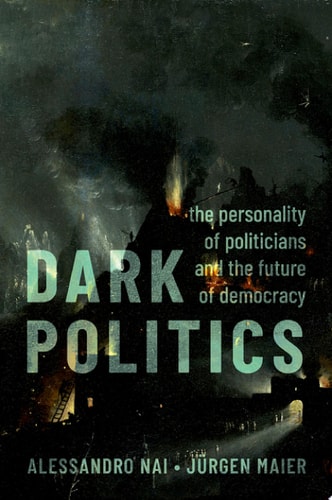
Dark Politics: The Personality of Politicians and the Future of Democracy
Author Description
Recent years have seen the rise of political figures with particularly abrasive, controversial, and aggressive personalities, who seem to take pleasure in introducing an uncivil tone into the political debate. From Trump in the USA to Bolsonaro in Brazil, the media increasingly spotlights political figures who adopt a transgressive political style that incorporates spectacular acts, exaggeration, calculated provocations, and political and socio-cultural taboos. Who are these aggressive political figures? Why are they successful? And what does it mean for democracy?Dark Politics is a novel exploration of the rise of aversive and antagonistic political figures worldwide. Drawing on new data from 100 recent elections, post-election surveys, and original experimental evidence, Alessandro Nai and Jürgen Maier provide the first large-scale comparative investigation into the "darker" sides of human personality in politicians--the "Dark Triad" of narcissism, psychopathy, and Machiavellianism. Nai and Maier show that dark traits are acutely present in populists, go hand in hand with more aggressive forms of campaign rhetoric, such as incivility and negativity, and are particularly appreciated by voters who themselves score high on such dark personality traits. Their analyses reveal that dark candidates are more likely to be electorally successful when running as an incumbent and tend to be associated with a better economic performance if elected. However, dark leaders can lead to increased cynicism in the public, democratic deconsolidation, and even a poorer response to the COVID-19 pandemic. Dark Politics provides a new way to understand contemporary politics by looking at the crucial role of dark personality traits in leaders and voters.
Menrva's Summary
THE THESIS
This book investigates the correlation between the 'Dark Triad' of personality traits—narcissism, psychopathy, and Machiavellianism—in political leaders and the subsequent impact on democratic stability and electoral success. Alessandro Nai and Jürgen Maier utilize an extensive dataset derived from 100 recent global elections, incorporating post-election surveys and original experimental evidence to construct their argument. They examine how these specific personality configurations influence campaign rhetoric, voter reception, and long-term governance outcomes. By bridging political science and personality psychology, the authors provide a framework for understanding the rise of transgressive political styles in the contemporary era.
THE SCOPE MAP
What You Will Find
- A comparative analysis of political figures across diverse international contexts, including the United States and Brazil.
- Empirical data linking the 'Dark Triad' of personality traits to specific campaign strategies like incivility and calculated provocation.
- Quantitative evidence regarding the electoral success of candidates exhibiting dark personality traits when running as incumbents.
- An assessment of the long-term consequences of such leadership on public cynicism, democratic deconsolidation, and crisis management.
THE AUTHORITY PERSPECTIVE
Experts identify this work as a significant contribution to the study of political psychology and the shifting landscape of modern campaigning. Readers frequently note the rigorous use of large-scale comparative data to substantiate the authors' claims regarding the intersection of personality and democratic health.
Page Count:
332
Publication Date:
2023-01-01
Publisher:
Oxford University Press
ISBN-10:
0197681751
ISBN-13:
9780197681756
Psychology
Politics
Systems Theory
Elections & Political Process
Democracy
Government
Sociology
Community Tags
Similar Books