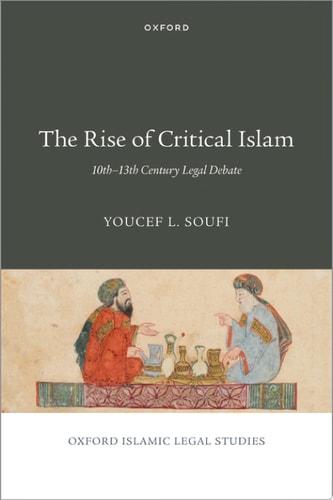
The Rise of Critical Islam: 10th-13th Century Legal Debate
0
0
As an Amazon Associate and affiliate partner, Menrva Books earns from qualifying purchases. Learn more
Author Description
In a richly narrated historical study, Youcef Soufi excavates an Islamic legal culture of critique from the 10th to 13th centuries. Focusing on the practice of munāẓara (disputation), Soufi explores how and why oral debates became a pervasive and revered part of the intellectual legal landscape of Iraq and Persia. Using the life and career of celebrated Iraqi jurist Abū Isḥāq al-Shīrāzī, he traces the formalization of debate gatherings at the dawn of the classical legal schools (al-madhāhib) in the early 10th century and analyzes the wider institutional, social, and discursive conditions that made debate an important feature of any jurist's practice.Pushing back against claims that classical Muslim jurists sought to weed out differences of opinion, The Rise of Critical Islam presents a community committed to the openness, fluidity, and continued exploration of the law. Challenging the view of debate gatherings simply as mechanisms of doctrinal resolution before codification, the study reveals a classical culture where critical debates were part of a continual and personal quest to discover God's law. In uncovering this classical legal culture, Soufi invites readers to question claims about the promise of secular critique in disciplining religious passions and forging human solidarity.
Menrva's Summary
THE THESIS
This study investigates how the practice of munāẓara, or oral disputation, functioned as a central mechanism for legal inquiry and intellectual development within Islamic jurisprudence from the 10th to the 13th centuries. Youcef Soufi, a scholar of Islamic legal history, utilizes the career of the jurist Abū Isḥāq al-Shīrāzī to examine the institutional and social frameworks of early classical legal schools. By analyzing primary source materials and historical records from Iraq and Persia, the author argues that these debates were not merely tools for doctrinal resolution, but essential expressions of a culture committed to the ongoing, fluid exploration of divine law.
THE SCOPE MAP
What You Will Find
- An analysis of the munāẓara tradition in 10th-13th century Iraq and Persia.
- A detailed examination of the professional life and pedagogical influence of Abū Isḥāq al-Shīrāzī.
- An exploration of the institutional and discursive conditions that formalized debate within the early madhāhib.
- A critical reassessment of the relationship between religious legal practice and the concept of secular critique.
THE AUTHORITY PERSPECTIVE
Scholars and historians of Islamic law identify this work as a significant contribution to the understanding of classical legal culture and the evolution of intellectual discourse. Readers frequently note the academic density of the prose, which provides a rigorous examination of how jurists navigated doctrinal differences through structured debate.
Page Count:
288
Publication Date:
2023-04-25
Publisher:
Oxford University Press
ISBN-10:
0197685005
ISBN-13:
9780197685006
History
Religion
Jurisprudence
Islamic Studies
Law history
Legal History
Professional Career & Trade
Community Tags
Similar Books