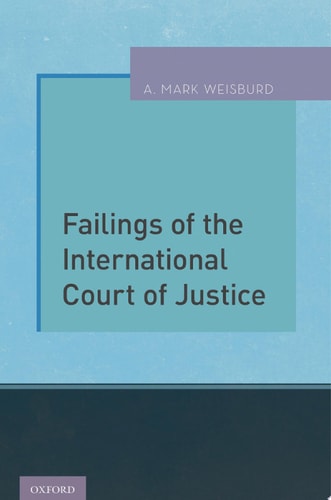
Failings of the International Court of Justice
0
0
As an Amazon Associate and affiliate partner, Menrva Books earns from qualifying purchases. Learn more
Author Description
Failings of the International Court of Justice critically examines the jurisprudence of the International Court of Justice. Even though the legal instrument that establishes the Court provides that its judgments have no formal precedential value, those judgments are treated as authoritative by international lawyers throughout the world. In this book, A. Mark Weisburd argues that the Court's decisions are, in a large minority of cases, poorly reasoned and doubtful as a matter of law, and therefore ought not to be accorded the deference they receive.The book seeks to demonstrate its thesis by a careful review of the Court's errors. It begins with an examination of the law that created and empowered the Court. It then describes the body of law upon which the Court was intended to base its decisions, and the mistakes in the arguments supporting the Court's drawing legal rules from other sources. The book goes on to analyze in detail cases in which the Court has made serious legal errors, first addressing procedural errors, then turning to mistakes in the application of substantive international law. The book closes with a quantitative summing up of the Court's performance, and a tentative explanation for its relatively disappointing record.
Menrva's Summary
THE THESIS
This work investigates whether the International Court of Justice (ICJ) deserves the high level of deference it receives from the global legal community, given the frequency of its flawed reasoning. A. Mark Weisburd, a legal scholar, utilizes a critical analysis of the Court's foundational instruments and a detailed review of its case law to challenge the authority of its judgments. He argues that a significant portion of the Court's output is legally unsound and that the international legal community should reconsider its reliance on these decisions as authoritative precedents.
THE SCOPE MAP
What You Will Find
- An analysis of the legal instruments establishing and empowering the ICJ.
- A critique of the sources from which the Court derives its legal rules.
- Detailed case studies focusing on procedural errors and misapplications of substantive international law.
- A quantitative assessment of the Court's overall performance record.
Scope Limits
- The book does not provide a comprehensive history of every case ever heard by the Court.
- It does not offer a political defense of the Court's institutional necessity or its role in conflict resolution.
THE AUTHORITY PERSPECTIVE
Legal scholars and practitioners often note the technical density of the prose and the provocative nature of the author's critique. Experts frequently highlight this text as a significant contribution to the debate regarding the legitimacy and judicial rigor of international tribunals.
Page Count:
430
Publication Date:
2015-01-01
Publisher:
Oxford University Press
ISBN-10:
0190299150
ISBN-13:
9780190299156
International relations
Legal History
International Law
Jurisprudence
Professional Career & Trade
International court of justice