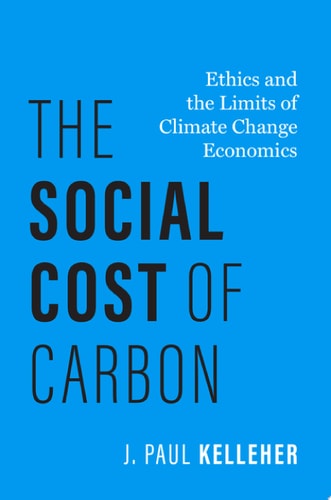
The Social Cost of Carbon: Ethics and the Limits of Climate Change Economics
Author Description
Called the "the most important number you've never heard of" by leading environmental economists, the social cost of carbon (SCC) aims to capture in a precise number the harm caused by emitting a single ton of carbon dioxide into the atmosphere. In The Social Cost of Carbon, J. Paul Kelleher offers a systematic analysis of the social cost of carbon, its theoretical basis, and its proper role in climate economics and climate policy design.The book explains that the SCC is not one concept but four, each of which is addressed to a distinct task in climate economics. Moreover, these concepts can be sorted into two families that correspond to the two branches of welfare economics, social choice theory and general equilibrium theory. Kelleher draws on these radically different theoretical frameworks to explain how a mathematically identical pair of SCC concepts can emerge from each. He then argues that the analytical power of each SCC concept is limited by its inability to fully capture the ethical considerations that bear on responsible climate policy.The book concludes by explaining how some SCC concepts can and should be put to work in real-world climate change policy analysis-providing practical advice for translating the SCC into tangible change.
Menrva's Summary
THE THESIS
This book investigates the theoretical foundations and ethical limitations of the social cost of carbon (SCC) as a metric for climate policy. J. Paul Kelleher, a scholar in philosophy and economics, examines how the SCC functions within welfare economics, specifically social choice theory and general equilibrium theory. By dissecting the mathematical and conceptual frameworks behind these metrics, the author argues that current economic models often fail to incorporate the full spectrum of ethical considerations necessary for responsible climate governance.
THE SCOPE MAP
What You Will Find
- A breakdown of the four distinct conceptualizations of the social cost of carbon.
- An analysis of the two primary branches of welfare economics: social choice theory and general equilibrium theory.
- A critical evaluation of the ethical constraints inherent in current climate economic modeling.
- Practical guidance on how to apply specific SCC concepts to real-world policy design and implementation.
THE AUTHORITY PERSPECTIVE
Experts recognize this work as a rigorous bridge between technical economic modeling and normative ethical philosophy. Readers frequently note the academic density of the prose, which serves as a foundational text for those seeking to understand the limitations of cost-benefit analysis in environmental policy.
Page Count:
296
Publication Date:
2025-02-25
Publisher:
Oxford University Press
ISBN-10:
0197687792
ISBN-13:
9780197687796
Politics
Economics
Philosophy
Ethics & Morality
Public Policy
Climate Change
Community Tags
Similar Books