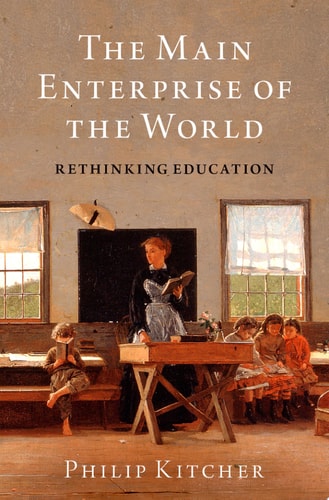
The Main Enterprise of the World: Rethinking Education
0
0
As an Amazon Associate and affiliate partner, Menrva Books earns from qualifying purchases. Learn more
Author Description
Philip Kitcher's The Main Enterprise of the World offers a sweeping vision of the goals of education. Kitcher considers the ways in which schools and universities should advance their goals, explores the social changes required to make high-quality education available to all, and argues that these reforms are economically sustainable. Kitcher build his arguments from three broad goals of education as an institution: career development and professionalization, civic participation, and human fulfilment. He shows that shifts in the workplace provide opportunities to focus on the latter two goals, and to liberate education from supposed economic constraints. By tying education to the strengthening of both individual lives and the foundations of democracy, he offers a humanistic rethinking of what education should try to achieve. Drawing on figures like Dewey, Mill, Atkinson, and others who have written deeply on education, both in theory and in practice, Kitcher offers an extensive reconsideration of how we might change our educational institutions to respond not just to the twenty-first century economy, but to the deeper need for lifelong human flourishing. The Main Enterprise of the World renews classical Pragmatism: with one eye on the ideal, and the other on the world, it presents a picture of education appropriate for our century.
Menrva's Summary
THE THESIS
What is the fundamental purpose of education in a modern democratic society, and how can institutions balance economic utility with the pursuit of human flourishing? Philip Kitcher, a philosopher of science and humanities scholar, utilizes the framework of classical Pragmatism to evaluate the current state of educational institutions. He argues that schools and universities must move beyond narrow professionalization to prioritize civic participation and individual fulfillment, asserting that such a shift is both socially necessary and economically viable.
THE SCOPE MAP
What You Will Find
- A tripartite framework for education: career development, civic engagement, and human fulfillment.
- Analysis of historical educational theories from figures such as John Dewey, John Stuart Mill, and William Atkinson.
- Economic arguments regarding the sustainability of educational reform in the twenty-first century.
Scope Limits
- The text does not provide a specific, step-by-step policy manual for immediate administrative implementation.
- It focuses primarily on the philosophical and societal goals of education rather than technical curriculum design.
THE AUTHORITY PERSPECTIVE
Experts recognize this work as a significant contribution to the philosophy of education, particularly for its attempt to reconcile classical Pragmatist ideals with contemporary economic realities. Readers frequently note the intellectual density of the prose, which requires a foundational understanding of philosophical discourse to fully appreciate the author's arguments.
Page Count:
434
Publication Date:
2021-01-01
Publisher:
Oxford University Press
ISBN-10:
0190928999
ISBN-13:
9780190928995
Philosophy
Politics
Social Science
Ethics & Morality
Educational Foundations
Education
Educational Reform
Pragmatism
Pedagogy
Humanities
Professional Career & Trade
Community Tags
Similar Books