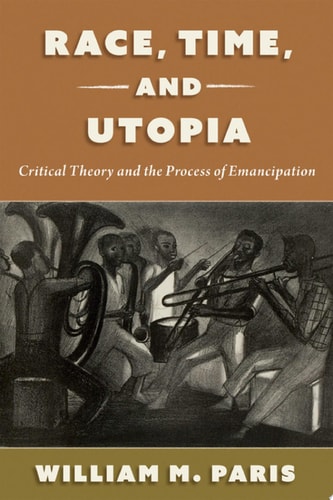
Race, Time, and Utopia: Critical Theory and the Process of Emancipation
0
0
As an Amazon Associate and affiliate partner, Menrva Books earns from qualifying purchases. Learn more
Author Description
Racial injustice, at its core, is the domination of time. Utopia has been one response to this domination. The racially dominated are not free to define what counts as "progress," they are not free from the accumulation of past injustices, and, most importantly, they are not free from the arbitrary organization of work in capitalist labor markets. Racially unjust societies are forms of life where the justifications for how to organize time around life, labor, and leisure are out of the hands of the dominated. In Race, Time, and Utopia, William Paris provides a theoretical account of utopia as the critical analysis of the sources of time domination and the struggle to create emancipatory forms of life.Rather than focusing on inclusion and equality before the law, as found in liberal theories of racial injustice, Paris analyses the neglected "utopian" tradition of justice in black political thought that insists justice can only be secured through the transformation of society as a whole. This transformation is nothing less than the democratic transformation of how organize and narrate our shared time. Bringing into conversation the work W.E.B Du Bois, Martin Delany, Marcus Garvey, Frantz Fanon, and James Boggs with the critical theory of Karl Marx, Ernst Bloch, Rahel Jaeggi, and Rainer Forst, Paris reconstructs a social theory and normative account of forms of life as the struggle over how time will be organized, asking "Can there be freedom without a new order of time?"
Menrva's Summary
THE THESIS
This book investigates whether true emancipation from racial injustice is possible without a fundamental restructuring of how time is organized within a society. William Paris, a scholar of critical theory and the philosophy of race, synthesizes black political thought with classical critical theory to argue that racial domination is essentially a form of temporal control. By examining the intersection of labor, history, and social progress, Paris posits that justice requires a democratic transformation of the structures that dictate how individuals experience and narrate their shared time.
THE SCOPE MAP
What You Will Find
- A theoretical framework linking racial injustice to the capitalist organization of labor and leisure.
- An analysis of the utopian tradition within black political thought, focusing on thinkers like W.E.B. Du Bois, Martin Delany, and Frantz Fanon.
- A synthesis of critical theory perspectives from figures such as Karl Marx, Ernst Bloch, and Rahel Jaeggi.
- A normative account of social forms of life as a site of struggle for temporal autonomy.
THE AUTHORITY PERSPECTIVE
Experts recognize this work as a significant contribution to the philosophy of race, noting its dense engagement with both continental critical theory and black radical traditions. Scholars frequently highlight the text as a rigorous attempt to move beyond liberal legal frameworks toward a more structural critique of societal organization.
Page Count:
240
Publication Date:
2024-11-06
Publisher:
Oxford University Press
ISBN-10:
0197698875
ISBN-13:
9780197698877
Philosophy
Politics
Ethics & Morality
Race Studies
Critical Theory
Social Science
Social Philosophy
Community Tags
Similar Books