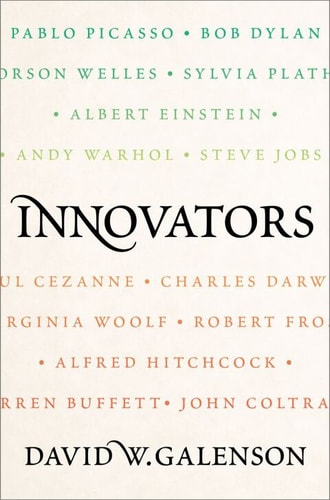
Innovators
0
0
As an Amazon Associate and affiliate partner, Menrva Books earns from qualifying purchases. Learn more
Author Description
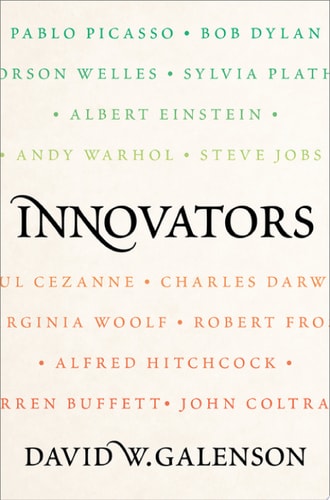
When in their lives are innovators most creative, and why? This book summarizes more than two decades of research prompted by this question. The result is an authoritative statement of a new unified theory of creativity, that overturns both popular and scholarly beliefs about the sources of human inventiveness. David Galenson shows that there are two distinctly different kinds of creativity in virtually every discipline. They result from very different goals and methods, and each produces a specific pattern of discovery over the life cycle.Conceptual innovators make bold leaps to formulate new ideas. The most radical conceptual innovations are made by brash young geniuses, who often lose their creativity thereafter. Great conceptual innovators analyzed in this book include Pablo Picasso, Albert Einstein, Orson Welles, Sylvia Plath, Andy Warhol, Bob Dylan, and Steve Jobs.Experimental innovators make discoveries gradually and unobtrusively, through careful observation and generalization. They gain knowledge over time, and make their greatest contributions late in their lives. Great experimental innovators considered in this book include Paul Cezanne, Charles Darwin, Virginia Woolf, Robert Frost, Alfed Hitchcock, John Coltrane, and Warren Buffett.From analysis of the careers of scores of artists, scholars, and entrepreneurs, this book provides a new understanding of the creative processes of great innovators, and reveals the systematic patterns that underlie the two life cycles of creativity. It will be of interest to anyone who seeks a deeper understanding of the sources of human creativity.
Menrva's Summary
THE THESIS
What are the fundamental life-cycle patterns of human creativity, and how do they differentiate the methods of great innovators? David W. Galenson, an economist and professor, synthesizes over twenty years of empirical research to propose a unified theory of creativity. He argues that human inventiveness is not a singular phenomenon but rather manifests in two distinct modes: conceptual and experimental. By analyzing the career trajectories of prominent artists, scientists, and entrepreneurs, Galenson demonstrates that these two types of creativity follow predictable, systematic patterns over the course of a lifetime.
THE SCOPE MAP
What You Will Find
- A comparative framework distinguishing between conceptual and experimental creative processes.
- Longitudinal analysis of career trajectories for figures such as Pablo Picasso, Albert Einstein, and Warren Buffett.
- Quantitative methodology applied to the history of art, literature, and science.
- Evidence-based conclusions regarding the age at which different types of innovators reach their peak productivity.
THE AUTHORITY PERSPECTIVE
Scholars and readers often note the book's rigorous economic approach to the study of artistic and intellectual history. Experts frequently cite this work as a foundational text for understanding the predictable life cycles of creative output across diverse disciplines.
Page Count:
424
Publication Date:
2024-01-01
Publisher:
Oxford University Press
ISBN-10:
019774561X
ISBN-13:
9780197745618
Business
Non-Fiction
Psychology
Biography
Creativity & Genius
Schools & Teaching
Sociology
Counseling Psychology
Economic History
Creativity
Community Tags
Other Editions(2)
Similar Books