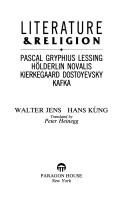
Literature and Religion
0
0
As an Amazon Associate and affiliate partner, Menrva Books earns from qualifying purchases. Learn more
Author Description
The great visions of Gryphius, Lessing, Holderlin, and Novalis, visions of peace, freedom, and humanity, have not been refuted. They were simply not realized in the modem era and they point to a different future...the lofty intellectuality and morality of Pascal the Catholic as well as the radical Christianness of Kierkegaard the Protestant have to be taken in here just as much as the mystical depth of Dostoyevsky the Russian and the enigmatic darkness of Kafka the Jew. The eclipse of God, the subsequent twilight of the gods, the downfall of the modem pseudogods can be followed by a new morning in a paradigm of postmodernity (a name for what is as yet unknown). Yes, let us look forward. If I read the signs of the times rightly, toward the end of our century rebellion against the Kafkaesque world is everywhere afoot.... Literature and religion in one: a theme of hope for a new futurean era that can bring forth literature in which great theology and great aesthetics enter once again into an exemplary intimacy. ùHans Knng, from Literature and Religion Up until the seventeenth century, Western culture was essentially synonymous with Christian culture. Then, on the very border between the medieval and the modem worlds, this unity of authority and belief began to crumble. For the first time, an intellectual life developed that was independent of the church, and modem, rational man surged toward new models of the world, society, the church, and theology. In Literature and Religion, Hans Knng and Walter Jens survey the complex, vital, and contradictory search for faith over the past three hundred years through the key works of eight great writers. At the dawn of modernity, Blaise Pascal was the prototype of the new modern man, measuring religion against developments in science, technology, and industrialization. Andreas Gryphius records the forces of the German Reformation, while Gotthold Lessing embodies the Enlightenment. Romanticism is represented by works of Ho1derlin
Menrva's Summary
THE THESIS
This book investigates the complex and often contradictory search for faith across three centuries of Western culture through the lens of eight pivotal literary figures. The authors, Hans Küng and Walter Jens, examine how the unity of Christian culture began to fragment at the dawn of modernity, leading to an intellectual life independent of the church. They explore the works of writers who grappled with new models of the world, society, and theology, measuring religion against scientific and industrial advancements. The book posits that the visions of peace, freedom, and humanity presented by these figures, though not realized in the modern era, offer hope for a new future where theology and aesthetics can achieve an exemplary intimacy.
THE SCOPE MAP
- Analysis of Blaise Pascal as a prototype of modern man, balancing religion with science and industrialization.
- Exploration of Andreas Gryphius's works in the context of the German Reformation.
- Examination of Gotthold Lessing's embodiment of Enlightenment ideals.
- Discussion of Romanticism through the works of Friedrich Hölderlin.
- Inclusion of the Catholic intellectuality and morality of Blaise Pascal.
- Consideration of the radical Protestant Christianity of Søren Kierkegaard.
- Exploration of the mystical depth of Fyodor Dostoevsky.
- Analysis of the enigmatic darkness found in Franz Kafka's writings.
THE AUTHORITY PERSPECTIVE
This work is recognized for its ambitious scope, tracing the evolution of faith and culture through the works of significant literary figures. The authors' interdisciplinary approach, blending theological insight with literary analysis, offers a unique perspective on the modern search for meaning. The book is likely to appeal to readers interested in the intersection of religion, philosophy, and literature, providing a thoughtful examination of enduring questions about humanity's spiritual condition. It suggests a potential for renewed cultural synthesis in the postmodern era.
Page Count:
308
Publication Date:
1991-01-01
ISBN-10:
1557782822
History
Philosophy
Literary Fiction
Religion
Non-Fiction
Literary Criticism
Theology
Community Tags
Similar Books