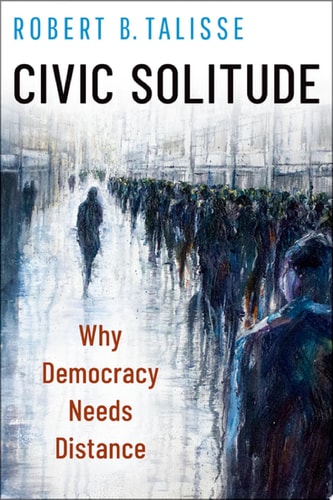
Civic Solitude: Why Democracy Needs Distance
0
0
As an Amazon Associate and affiliate partner, Menrva Books earns from qualifying purchases. Learn more
Author Description
An internet search of the phrase "this is what democracy looks like" returns thousands of images of people assembled in public for the purpose of collective action. But is group collaboration truly the defining feature of effective democracy? Robert B. Talisse suggests that while group action is essential to democracy, action without reflection can present insidious challenges, as individuals' perspectives can be distorted by group dynamics.The culprit is a cognitive dynamic called belief polarization. As we interact with our political allies, we are exposed to forces that render us more radical in our beliefs and increasingly hostile to those who do not share them. What's more, the social environments we inhabit in our day-to-day lives are sorted along partisan lines. We are surrounded by triggers of political extremity and animosity. Thus, our ordinary activities encourage the attitude that democracy is possible only when everyone agrees--a profoundly antidemocratic stance.Drawing on extensive research about polarization and partisanship, Talisse argues that certain core democratic capacities can be cultivated only at a distance from the political fray. If we are to meet the responsibilities of democratic citizenship, we must occasionally step away from our allies and opponents alike. We can perform this self-work only in secluded settings where we can engage in civic reflection that is not prepackaged in the idiom of our political divides, allowing us to contemplate political circumstances that are not our own.
Menrva's Summary
THE THESIS
Does the modern emphasis on collective political action undermine the reflective capacity necessary for a functioning democracy? Robert B. Talisse, a professor of philosophy and political science, examines the psychological and social mechanisms that drive political polarization. He argues that constant immersion in partisan group dynamics degrades individual judgment, proposing that citizens must cultivate periods of solitude to engage in independent civic reflection.
THE SCOPE MAP
What You Will Find
- Analysis of belief polarization and its impact on individual political cognition
- Examination of how partisan social environments influence radicalization
- Theoretical framework for the necessity of intellectual distance in democratic citizenship
- Critique of the assumption that democracy requires constant collective agreement
THE AUTHORITY PERSPECTIVE
Experts in political theory identify this work as a significant contribution to the study of democratic health in the digital age. Readers frequently note the accessible yet rigorous philosophical approach Talisse takes when addressing the dangers of groupthink.
Page Count:
208
Publication Date:
2024-11-22
Publisher:
Oxford University Press
ISBN-10:
0197752160
ISBN-13:
9780197752166
Politics
Philosophy
Democracy
Social Philosophy
Political Theory
Sociology
Community Tags
Similar Books