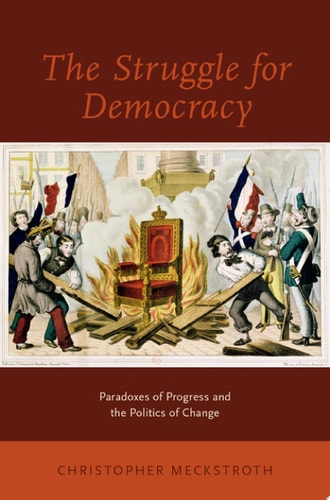
Struggle for Democracy: Paradoxes of Progress and the Politics of Change
0
0
As an Amazon Associate and affiliate partner, Menrva Books earns from qualifying purchases. Learn more
Author Description
Revolutionaries, Counter-revolutionaries, And Reformers The World Over Appeal To Democracy To Justify Their Actions. But When Political Factions Compete Over The Right To Act In The People's Name, Who Is To Decide? Although The Problem Is As Old As The Great Revolutions Of The Seventeenth And Eighteenth Centuries, Events From The Arab Spring To Secession Referendums Suggest That Today It Is Hardly Any Closer To Being Solved. This Book Defends A New Theory Of Democratic Legitimacy And Change That Provides An Answer. Christopher Meckstroth Shows Why Familiar Views That Identify Democracy With Timeless Principles Or Institutions Fall Into Paradox When Asked To Make Sense Of Democratic Founding And Change. Solving The Problem, He Argues, Requires Shifting Focus To The Historical Conditions Under Which Citizens Work Out What It Will Mean To Govern Themselves In A Democratic Way. The Only Way Of Sorting Out Disputes Without Faith In Progress Is To Show, In Socratic Fashion, That Some Parties' Claims To Speak For The People Cannot Hold Up Even On Their Own Terms. Meckstroth Builds His Argument On Provocative And Closely-argued Interpretations Of Plato, Kant, And Hegel, Suggesting That Familiar Views Of Them As Foundationalist Metaphysicians Misunderstand Their Debt To A Method Of Radical Doubt Pioneered By Socrates. Recovering This Tradition Of Antifoundational Argument Requires Rethinking The Place Of German Idealism In The History Of Political Thought And Opens New Directions For Contemporary Democratic Theory. The Historical And Socratic Theory Of Democracy The Book Defends Makes Possible An Entirely New Way Of Approaching Struggles Over Contested Notions Of Progress, Popular Sovereignty, Political Judgment And Democratic Change.
Menrva's Summary
THE THESIS
How can democratic legitimacy be established when competing political factions claim to act in the name of the people? Christopher Meckstroth, a scholar of political theory, challenges the conventional reliance on timeless principles or fixed institutions to define democracy. He argues that democratic legitimacy is not a static condition but a historical process, proposing an antifoundationalist framework rooted in Socratic doubt to resolve disputes over political change and popular sovereignty.
THE SCOPE MAP
What You Will Find
- A reinterpretation of the political philosophies of Plato, Kant, and Hegel.
- A critique of foundationalist approaches to democratic theory.
- A methodology for analyzing political disputes through the lens of radical doubt.
- An examination of historical and contemporary struggles over democratic change.
Scope Limits
- The text does not provide a practical policy manual for modern governance.
- It does not offer a comprehensive history of all democratic movements globally.
THE AUTHORITY PERSPECTIVE
Scholars in political theory recognize this work as a significant contribution to the study of German Idealism and its relevance to contemporary democratic discourse. Readers frequently note the academic density of the prose, which requires a strong background in classical and modern political philosophy to fully engage with the author's arguments.
Page Count:
304
Publication Date:
2015-01-01
Publisher:
Oxford University Press, Incorporated
ISBN-10:
0190213930
ISBN-13:
9780190213930
Philosophy
Democracy
Political Theory
History of Ideas
Community Tags
Other Editions(3)
Similar Books
Reader Comments
Share Your Thoughts
No comments yet. Be the first to share your thoughts!