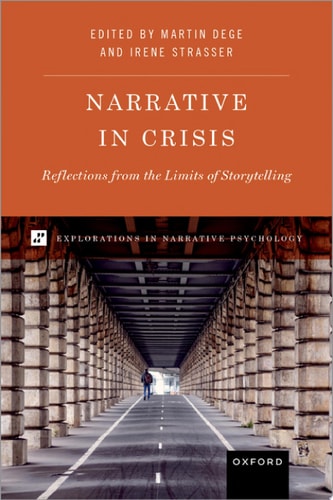
Narrative in Crisis: Reflections from the Limits of Storytelling
0
0
As an Amazon Associate and affiliate partner, Menrva Books earns from qualifying purchases. Learn more
Author Description
In this volume, distinguished scholars of narrative provide their early attempts - triggered by the COVID-19 pandemic - to understand "crises" from a narrative perspective. They discuss the narrative notions of crises as an ongoing situation, thereby uncovering ideals of stability and certainty as epistemologically questionable psychological concepts. The authors all start with insight into early considerations, from mid-2020, at a time still without vaccines and variants. They revisit their thoughts over the course of the ongoing pandemic and relate their research perspective to autoethnographic and biographical approaches to "crisis narratives." As scholars and citizens, they share vulnerable moments of uncertainty - what we don't know and will not know - and draw on past collective experiences. What did we learn from the Spanish flu? How well do experts and journalists really understand what those numbers are supposed to signify? How unparalleled is the unprecedented experience for individuals who have experienced war, sieges, and previous pandemics? And finally, will we ever learn to live with the virus?The chapters shed light on ambiguities relating to us and the other, rational, and irrational approaches to navigating crises, and other ambivalences, without aiming to solve them. They investigate levels of the individual, academic work, and society and highlight stories of the unknown or yet-to-be known by making them accessible through thorough reflection, pushing back the all-too-simplified stories we hear in everyday discourses.
Menrva's Summary
THE THESIS
This volume investigates how the COVID-19 pandemic challenged established narrative frameworks and exposed the fragility of human concepts regarding stability and certainty. Irene Strasser and Martin Dege, alongside a cohort of narrative scholars, utilize autoethnographic and biographical methods to examine the psychological impact of global crisis. By revisiting their initial research from mid-2020, the contributors argue that crises are not merely events to be overcome but ongoing conditions that reveal the limitations of traditional storytelling in making sense of the unknown.
THE SCOPE MAP
What You Will Find
- Analysis of crisis narratives through autoethnographic and biographical research methods.
- Comparative historical perspectives, including lessons drawn from the Spanish flu and previous global conflicts.
- Critical examination of how media and experts communicate statistical data to the public.
- Exploration of the psychological tension between rational and irrational responses to prolonged uncertainty.
THE AUTHORITY PERSPECTIVE
Experts highlight this work as a significant contribution to narrative psychology, particularly for its willingness to embrace ambiguity rather than offering simplified solutions. Readers frequently note the academic density of the prose, which serves as a rigorous examination of how scholars process collective trauma in real time.
Page Count:
184
Publication Date:
2024-01-01
Publisher:
Oxford University Press
ISBN-10:
019775175X
ISBN-13:
9780197751756
Psychology
Non-Fiction
Academic
Sociology
Counseling Psychology
Medicine
Community Tags
Similar Books