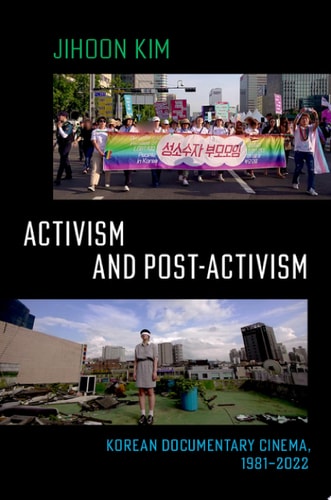
Activism and Post-activism: Korean Documentary Cinema, 1981-2022
0
0
As an Amazon Associate and affiliate partner, Menrva Books earns from qualifying purchases. Learn more
Author Description
Activism and Post-activism: Korean Documentary Cinema, 1981--2022 is a new book about nonfiction filmmaking in the private and independent sectors of South Korean cinema and media from the early 1980s to the present day. Drawing on the methodologies of documentary studies, experimental film and video, digital cinema, local discourses on independent documentary, and the literature on the social changes of South Korea, author Jihoon Kim historicizes the formation and development of Korean independent documentary in close dialogue with South Korea's social movements. From the 1980s mass anti-dictatorship movement to twenty-first-century labor issues, feminism, LGBT rights, environmental justice, and key events such as the Sewol Ferry disaster and the Candlelight Protests, Kim offers a comprehensive history of Korean social change documentaries in terms of their activist tradition.At the same time, Kim also maps out the formal and aesthetic divergences of twenty-first-century Korean documentary cinema beyond the activist tradition, while also demonstrating how they have inherited and dynamically renewed the tradition's engagement with contested reality and history. Making the tripartite connections between the socio-political history of South Korea, documentary's aesthetics and politics, and the shifting institutional and technological evolution of documentary production and distribution, the book argues that what is unique about this forty-year history of South Korean documentary cinema is the intensive and compressed coevolution of its two interlocked tendencies: activism and post-activism.
Menrva's Summary
THE THESIS
How has the evolution of South Korean documentary cinema functioned as both a tool for political activism and a site for aesthetic innovation over the past four decades? Author Jihoon Kim, a scholar of film and media, utilizes a multidisciplinary framework that integrates documentary studies, experimental media theory, and South Korean socio-political history. He argues that the trajectory of Korean independent documentary is defined by a compressed coevolution between traditional activist filmmaking and a contemporary shift toward post-activist formal experimentation.
THE SCOPE MAP
What You Will Find
- A historical analysis of South Korean independent documentary from 1981 to 2022.
- Examination of key social movements including anti-dictatorship protests, labor rights, feminism, and environmental justice.
- Analysis of the aesthetic and formal shifts in documentary production following the Sewol Ferry disaster and the Candlelight Protests.
- A study of the institutional and technological evolution of documentary distribution within the South Korean media landscape.
THE AUTHORITY PERSPECTIVE
Experts identify this work as a foundational text for understanding the intersection of political history and cinematic form in East Asia. Readers frequently note the academic density of the prose, which provides a rigorous scholarly examination of the relationship between social change and documentary practice.
Page Count:
328
Publication Date:
2024-01-01
Publisher:
Oxford University Press
ISBN-10:
0197760422
ISBN-13:
9780197760420
History
Documentary
Media Studies
Film Studies
Community Tags
Similar Books