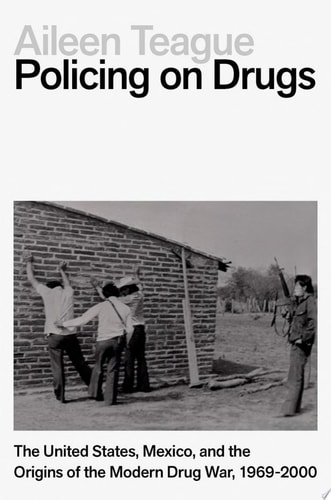
Policing on Drugs: The United States, Mexico, and the Origins of the Modern Drug War, 1969-2000
0
0
As an Amazon Associate and affiliate partner, Menrva Books earns from qualifying purchases. Learn more
Author Description
Today, images of cartels, security agents donning face coverings, graphs depicting egregious murder rates, and military guards at US border crossings influence the world's perception of Mexico. Mexico's so-called drug war, as generally conceived by journalists and academics, was the product of recent cartel turf wars, the end of the PRI's single party rule in 2000, and enhanced US border security measures post-9/11. These explanations are compelling, but they overlook state actions beginning in the 1970s that set the foundation for drug violence over the longer term.In Policing on Drugs, Aileen Teague chronicles a largely ignored but critical prehistory of intensified bilateral antidrug efforts by exploring their origins and inherent contradictions in Mexico. Beginning in the 1960s, US leaders externalized their aggressive domestic drug control practices by forcing junior partners such as Mexico into adopting their policies. Leaders on both sides of the border situated counternarcotics within a larger paradigm of militarized policing, which increased the power and influence of the military and aggressive counternarcotics in both countries. However, different security imperatives motivated US and Mexican agents, complicating enforcement in Mexico. Between 1969 and 2000, Mexico's embrace of America's punitive antidrug policies strengthened the coercive capacities of the Mexican state, exacerbated crime, and were so ineffective in an era of open trade blocs that they hastened the expansion of the drug trade.Drawing on such sources as records from the Drug Enforcement Administration (DEA), the US State Department, interviews with key officials, accounts from Mexican journalists, and rarely seen Mexican intelligence reports, Teague relates the war on drugs as a transnational story with deep historical roots in US and Mexican conceptions of policing and security. The negative impacts of US-led counternarcotics policies in Mexico can be attributed to the complex relationship.
Menrva's Summary
THE THESIS
This work investigates how the implementation of aggressive, US-led counternarcotics policies in Mexico between 1969 and 2000 fundamentally shaped the modern drug war and exacerbated regional violence. Aileen Teague, a scholar of international history, utilizes a vast array of primary sources to challenge the conventional narrative that Mexico's drug violence is a strictly modern phenomenon. By examining the bilateral relationship between the two nations, she argues that the externalization of American punitive drug control practices empowered the Mexican military and inadvertently facilitated the expansion of the drug trade during an era of increasing economic integration.
THE SCOPE MAP
What You Will Find
- Historical analysis of US-Mexico bilateral drug policy from 1969 to 2000.
- Examination of the militarization of policing and its impact on state coercive capacity.
- Evidence derived from DEA records, US State Department files, and previously unseen Mexican intelligence reports.
- A critical assessment of how punitive antidrug strategies failed to curb trade while simultaneously increasing domestic crime rates.
THE AUTHORITY PERSPECTIVE
Experts recognize this text as a significant contribution to the historical understanding of the transnational drug war. Scholars frequently highlight the depth of the archival research and the clarity with which Teague connects past policy decisions to contemporary security challenges.
Page Count:
232
Publication Date:
2025-10-20
Publisher:
Oxford University Press
ISBN-10:
0197761860
ISBN-13:
9780197761861
History
Mexico
Americas
Criminology
International relations
Community Tags
Similar Books