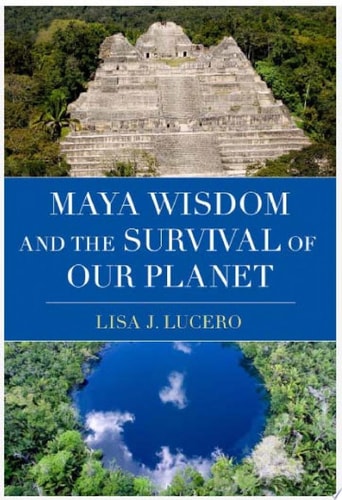
Maya Wisdom and the Survival of Our Planet
0
0
As an Amazon Associate and affiliate partner, Menrva Books earns from qualifying purchases. Learn more
Author Description
We now live in the Anthropocene, the first epoch of our own making. We have altered the Earth's atmosphere, landscapes, and bodies of water. The burning of fossil fuels has warmed the planet enough to change weather patterns, melt glaciers, and raise sea levels, a situation made worse by rampant deforestation and resource depletion. Many look to governments to confront these existential challenges. In Maya Wisdom and the Survival of Our Planet, Lisa Lucero looks to the Maya, past and present.Through the lens of the traditional Maya inclusive worldview--one in which humans are part of the world, not separate from it, and where everything is connected--Lucero provides a practical roadmap on how to sustainably address climate change and environmental degradation. She shows how the Maya collaborate with rather than try to subjugate forests, animals, soils, water, and other nonhuman entities. The Maya sustainably farmed for millennia and provided goods, labor, and services to their kings in cities. In return, kings performed vital ceremonies to the Rain God Chahk, other gods, and ancestors to replenish urban reservoirs that lasted throughout the long dry season--a balancing act that worked for over 1,000 years.Lucero shows how approaches to tackle climate change from the bottom-up, beginning with the family or household, are just as important as top-down governmental mitigation, and how learning from traditional knowledge is vital for the survival of us all. She brings to life the tropical jungles of Central America and reveals the valuable solutions its ancient and contemporary inhabitants offer us to save our planet.
Menrva's Summary
THE THESIS
Can the traditional, inclusive worldview of the Maya civilization provide a viable framework for addressing the existential threats of the Anthropocene? Lisa J. Lucero, a professor of anthropology, synthesizes archaeological evidence and contemporary Maya practices to argue that shifting from a human-centric to an interconnected environmental perspective is necessary for planetary survival. By examining how ancient Maya societies balanced resource management with ritualistic stewardship, she proposes a bottom-up approach to climate mitigation that integrates traditional ecological knowledge with modern sustainability efforts.
THE SCOPE MAP
What You Will Find
- Historical analysis of Maya agricultural and water management systems spanning over 1,000 years.
- Examination of the symbiotic relationship between ancient Maya urban centers and their surrounding tropical ecosystems.
- Comparative study of top-down governmental climate policy versus household-level traditional ecological practices.
- Methodologies for incorporating indigenous knowledge into contemporary environmental conservation strategies.
THE AUTHORITY PERSPECTIVE
Experts in anthropology and environmental studies highlight this work as a bridge between archaeological research and modern climate discourse. Readers frequently note the accessibility of the prose, which effectively translates complex cultural history into actionable environmental philosophy.
Page Count:
240
Publication Date:
2025-01-27
Publisher:
Oxford University Press
ISBN-10:
019776570X
ISBN-13:
9780197765708
Politics
History
Climate Change
Mayas
Ethnic Studies
Anthropology
Sustainability
Ethnobiology
Antiquités
Climatology
Environmental archaeology
Climat
Traditional Knowledge
Community Tags
Other Editions(2)
Similar Books