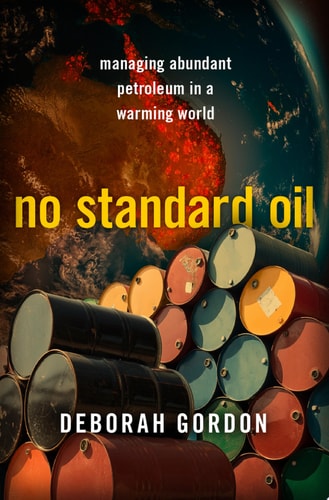
No Standard Oil: Managing Abundant Petroleum in a Warming World
0
0
As an Amazon Associate and affiliate partner, Menrva Books earns from qualifying purchases. Learn more
Author Description
In No Standard Oil, environmental policy expert Deborah Gordon examines the widely varying climate impacts of global oils and gases, and proposes solutions to cut greenhouse gas emissions in this sector while making sustainable progress in transitioning to a carbon-free energy future.The next decade will be decisive in the fight against climate change. It will be impossible to hold the planet to a 1.5o C temperature rise without controlling methane and CO2 emissions from the oil and gas sector. Contrary to popular belief, the world will not run out of these resources anytime soon. Consumers will continue to demand these abundant resources to fuel their cars, heat their homes, and produce everyday goods like shampoo, pajamas, and paint. But it is becoming more environmentally damaging to supply energy using technologies like fracking oil and liquefying gas. Policymakers, financial investors, environmental advocates, and citizens need to understand what oil and gas are doing to our climate to inform decision-making.In No Standard Oil, Deborah Gordon shows that no two oils or gases are environmentally alike. Each has a distinct, quantifiable climate impact. While all oils and gases pollute, some are much worse for the climate than others. In clear, accessible language, Gordon explains the results of the Oil Climate Index Plus Gas (OCI+), an innovative, open source model that estimates global oil and gas emissions. Gordon identifies the oils and gases from every region of the globe-along with the specific production, processing, and refining activities-that are the most harmful to the planet, and proposes innovative solutions to reduce their climate footprints.Global climate stabilization cannot afford to wait for oil and gas to run out. No Standard Oil shows how we can take immediate, practical steps to cut greenhouse gas emissions in the crucial oil and gas sector while making sustainable progress in transitioning to a carbon-free energy future.
Menrva's Summary
THE THESIS
This book investigates how the extreme variability in the climate impacts of different global oil and gas sources necessitates a more nuanced regulatory approach to achieve carbon reduction goals. Deborah Gordon, an environmental policy expert, utilizes the Oil Climate Index Plus Gas (OCI+) model to analyze the lifecycle emissions of various petroleum products. She argues that because global oil and gas supplies remain abundant, the focus must shift from resource scarcity to the specific environmental costs associated with extraction, processing, and refining methods.
THE SCOPE MAP
What You Will Find
- Analysis of the Oil Climate Index Plus Gas (OCI+) open-source model.
- Comparative data on greenhouse gas emissions across different global oil and gas regions.
- Proposed policy frameworks for mitigating climate footprints in the energy sector.
Scope Limits
- The text does not provide a comprehensive technical manual for petroleum engineering or refining operations.
- It does not offer a definitive timeline for the total global phase-out of fossil fuels.
THE AUTHORITY PERSPECTIVE
Experts and policy analysts recognize this work as a critical contribution to understanding the heterogeneity of fossil fuel emissions. Readers frequently note that the book provides a clear, data-driven methodology for policymakers to prioritize climate-conscious energy decisions.
Page Count:
368
Publication Date:
2021-11-01
Publisher:
Oxford University Press
ISBN-10:
0190069473
ISBN-13:
9780190069476
Non-Fiction
Politics
Earth Sciences
Public Policy
Climatology
Politics & Government
General
Climate Change
New Used & Rental Textbooks
Energy Industry
Sustainability
Community Tags
Other Editions(2)
Similar Books










Reader Comments
Share Your Thoughts
No comments yet. Be the first to share your thoughts!