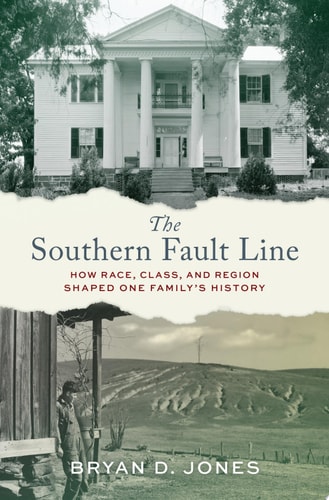
The Southern Fault Line: How Race, Class, and Region Shaped One Family's History
0
0
As an Amazon Associate and affiliate partner, Menrva Books earns from qualifying purchases. Learn more
Author Description
A highly original reinterpretation of how race and class shaped the entirety of Southern history through the experience of four interconnected family lines.The Southern Fault Line explores the under-appreciated division in the South between the oligarchic rule of plantation owners and industrialists on the one hand, and the more democratic mindset of the mountain-dwelling small farmers on the other. These two mindsets were in continual tension from the 1800s to the 1960s, when the adherents of the more democratic side of the struggle capitulated to the oligarchical side in response to the Civil Rights movement.Bryan Jones draws from his own family's centuries-old history in the region to explore the rise and fall of the "two minds" of the South. Through a comparison of the experiences of a slaveholding line in his family with three non-slaveholding lines, Jones provides a rich history of the politics of both class and race in the region from the Founding era to the present. The slaveholding side of his family settled in Black Belt Alabama, while ancestral members of the other side of his family were poorer uplanders. In the 1890s, the latter supported the burgeoning populist movement, which for a short window of time tried to unite poor Blacks and poor whites against the patrician planter class and industrialists. After a series of close elections, the planter class was able to stanch the populist tide. They did this in large part by sowing racial division among populism's supporters. Indeed, one of Jones' ancestors helped draft the 1901 Alabama constitution that made Jim Crow the law of the state.Throughout, Jones shows how deep the political differences were between the two regions, with oligarchy characterizing the slaveholding region and a more democratic ethos shaping the non-slaveholding areas. Jones serves as the final observer, a white boy observing not only the demise of the Jim Crow South, but--in the wake of the Civil Rights movement--the demise of the mo
Menrva's Summary
THE THESIS
This work investigates how the intersection of race, class, and regional geography defined the political and social evolution of the American South. Bryan D. Jones, a scholar with deep ancestral roots in the region, utilizes his own family history as a primary case study to examine the tension between the oligarchic plantation class and the democratic ethos of mountain-dwelling small farmers. By contrasting the experiences of his slaveholding ancestors in Alabama with his non-slaveholding, populist-leaning kin, Jones argues that the eventual dominance of the planter class was achieved through the deliberate cultivation of racial division to suppress cross-racial populist alliances.
THE SCOPE MAP
What You Will Find
- A longitudinal analysis of Southern political history from the Founding era through the 1960s.
- A comparative study of four distinct, interconnected family lineages representing different socioeconomic strata.
- An examination of the 1890s populist movement and its attempt to unite poor Blacks and whites.
- A detailed look at the legislative mechanisms, such as the 1901 Alabama constitution, used to codify Jim Crow laws.
THE AUTHORITY PERSPECTIVE
Experts note that this text provides a valuable micro-historical lens through which to view broader regional political trends. Readers frequently highlight the author's ability to synthesize personal genealogy with rigorous historical analysis to explain the collapse of democratic movements in the post-Civil Rights era.
Page Count:
448
Publication Date:
2025-03-03
Publisher:
Oxford University Press
ISBN-10:
0197770428
ISBN-13:
9780197770429
Politics
History
Biography
Sociology
Americas
Race Relations
Southern History
Community Tags
Similar Books