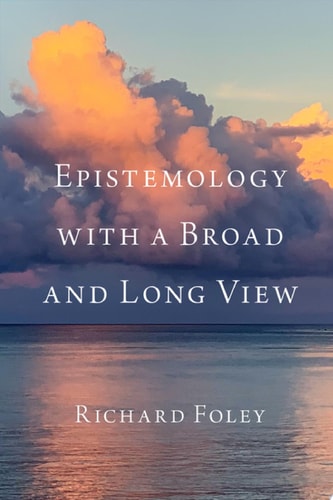
Epistemology with a Broad and Long View
0
0
As an Amazon Associate and affiliate partner, Menrva Books earns from qualifying purchases. Learn more
Author Description
Epistemology with a Broad and Long View is an original and provocative challenge to standard epistemologies that assume that the reasonability of beliefs is wholly a function of considerations indicating their current likelihood. Richard Foley argues that this view, although widely accepted, is excessively narrow.Foley argues for a less constricted epistemology that acknowledges that, in addition to beliefs and degrees-of-confidence, intellectual commitments play a vital role in our intellectual lives; that the key issue in overseeing all these attitudes is whether it's appropriate to revise or add to them for our purposes; and that a mixture of practical, ethical, political, social, and long-term intellectual considerations, and not just ones about current likelihood, determine what's appropriate. On this view, there is no purely epistemic notion of reasonability. There are truth-related considerations, but except in those rare cases where there is complete certainty, they don't determine the reasonability of our belief-like attitudes. They do so only in partnership with a broad and long range of non-truth-related considerations. Foley suggests that a failure to recognize these partnerships can result in theoretical confusion, and also can impede our ability to understand and deal with dogmatists who have unlikely or toxic views. Foley's overriding theme is that a broad and long view is as necessary for making sense of the reasonableness or unreasonableness of our opinions, as it is for other aspects of our lives.
Menrva's Summary
THE THESIS
This book investigates whether the standard focus on current likelihood is sufficient to determine the reasonability of human beliefs. Richard W. Foley, a prominent philosopher, challenges the prevailing narrow epistemological framework that equates belief reasonability solely with truth-related indicators. He proposes a more expansive model that integrates intellectual commitments, practical goals, and ethical considerations into the evaluation of our cognitive attitudes. By arguing that non-truth-related factors are essential to understanding belief formation, Foley seeks to resolve theoretical confusion regarding how individuals maintain and revise their opinions.
THE SCOPE MAP
What You Will Find
- A critique of traditional epistemological models that prioritize current likelihood.
- An analysis of the role of intellectual commitments alongside degrees of confidence.
- A framework for evaluating belief revision based on practical, ethical, and social purposes.
- Strategies for addressing dogmatism and toxic belief systems through a broader intellectual lens.
THE AUTHORITY PERSPECTIVE
Experts recognize this work as a significant contribution to contemporary epistemology that pushes back against purely truth-centered models of rationality. Readers frequently note the academic density of the prose, which is intended for those already familiar with foundational philosophical discourse.
Page Count:
152
Publication Date:
2024-08-09
Publisher:
Oxford University Press
ISBN-10:
0197772781
ISBN-13:
9780197772782
Politics
Non-Fiction
Philosophy
Logic
Knowledge Theory
Ethics
Epistemology
Community Tags
Similar Books