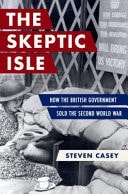
The Skeptic Isle: How the British Government Sold the Second World War
0
0
As an Amazon Associate and affiliate partner, Menrva Books earns from qualifying purchases. Learn more
Author Description
A major reassessment of the British government's communication of the goals of World War II and how its propaganda undermined the people's faith in the reliability of war news and the credibility of political leaders. While waging war against enemies overseas, governments also need to win the hearts and minds of their own citizens. The media is critical to delivering the official message, raising public support for war, maintaining morale, spelling out what is to be achieved, downplaying setbacks, and presenting a bright vision of the postwar future. In public memory, the British people were united in their support for World War II. Yet this popular image of the People's War neglects the fact that the war had to be sold. In this work stretching from appeasement in 1938 through victory, award-winning historian Steven Casey examines how media, government, and armed forces worked to convince the British public to support the war, as well as the ways the British home front often questioned and challenged the official line. Using a vast array of primary sources, some of them previously untapped, he looks at the broad range of problems and policies that needed to be defended and explained, censored and concealed. The venues range widely from the battlefield to the football field, from the rubble-strewn cities of blitzed Britain to the faraway outposts of Empire. In his chronological narrative of the war, Casey shines light on numerous high-profile episodes, including Munich and Dunkirk, the Battle of Britain and Blitz, evacuation and rationing, and the campaigns in the Africa, Asia, and Europe. Throughout, Casey stresses how the British military forged a relationship with reporters, how this relationship shaped news coverage of the fighting, and how this coverage in turn exerted a profound impact on every other dimension of the government's private and public actions. No one before has examined how all the branches of the armed services kept the home front informed abou
Menrva's Summary
THE THESIS
This work investigates how the British government managed the communication of war goals and how its propaganda efforts influenced public trust in political leadership and news reliability during World War II. Steven Casey, an award-winning historian, utilizes a vast array of primary sources to analyze the complex relationship between the state, the media, and the home front. He argues that the narrative of a universally united 'People's War' obscures the active, often contentious process of selling the conflict to a skeptical public. The book provides a chronological framework that tracks how government policies, censorship, and military reporting shaped the national consciousness from the period of appeasement through the final victory.
THE SCOPE MAP
What You Will Find
- A chronological analysis of British propaganda and information management from 1938 to 1945.
- Examination of the symbiotic relationship between the British military and the press corps.
- Extensive use of previously untapped primary source documents and government archives.
- Case studies of major events including the Munich Agreement, the Dunkirk evacuation, the Blitz, and various international military campaigns.
THE AUTHORITY PERSPECTIVE
Historians and scholars recognize this work as a comprehensive examination of the mechanics of wartime information control. Readers frequently note the academic density of the prose and the depth of the archival research presented by the author.
Page Count:
384
Publication Date:
2025-05-01
Publisher:
Oxford University Press
ISBN-10:
019778187X
ISBN-13:
9780197781876
History
British History
Europe
Media Studies
Military History
Community Tags
Similar Books