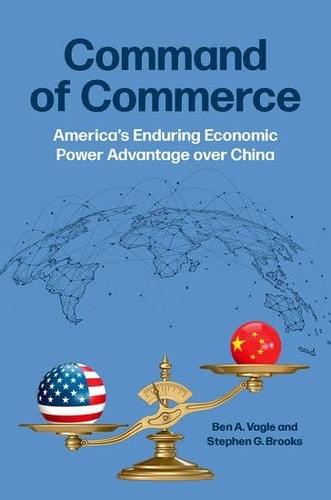
Command of Commerce: America's Enduring Economic Power Advantage over China
0
0
As an Amazon Associate and affiliate partner, Menrva Books earns from qualifying purchases. Learn more
Author Description
The conventional wisdom has held that China's economic power is very close to America's and that Washington cannot undertake a broad economic cutoff of China without hurting itself as much, or more. In Command of Commerce, Ben A. Vagle and Stephen G. Brooks show the conventional wisdom is wrong on both fronts. The authors argue that America's economic power has been underestimated because conventional economic measures have ignored America's unprecedented control over the world's largest multinational corporations. They further argue that China's economic power has been overestimated due to Beijing's manipulation of its economic data and measurement issues presented by China's uniquely structured economy. The authors also show Washington could impose massive, disproportionate harm on Beijing if it imposed a broad economic cutoff on China in cooperation with its allies or via a distant naval blockade. Across six scenarios, China's short-term economic losses from a broad cutoff range from being 5 to 11 times higher than America's. And in the long run, America and almost all its allies would return to previous economic growth levels; in contrast, China's growth would be permanently degraded.
Menrva's Summary
THE THESIS
This book investigates the validity of the conventional wisdom regarding the relative economic power of the United States versus China. Authors Ben A. Vagle and Stephen G. Brooks utilize a framework that prioritizes control over multinational corporations and scrutinizes the reliability of Chinese economic data. They argue that the United States maintains a significant structural advantage that allows for disproportionate leverage in the event of a broad economic cutoff or naval blockade.
THE SCOPE MAP
What You Will Find
- Analysis of American control over global multinational corporations as a primary indicator of economic power.
- Evaluation of data manipulation and structural measurement issues within the Chinese economy.
- Six distinct scenarios modeling the economic impact of a broad cutoff or naval blockade on both nations.
- Long-term projections comparing economic growth recovery rates between the United States, its allies, and China.
THE AUTHORITY PERSPECTIVE
Experts in international relations and economic policy view this work as a significant challenge to prevailing assumptions about the parity between the two superpowers. Readers frequently note the technical rigor of the scenario modeling and the authors' focus on corporate influence as a key differentiator in modern geopolitical analysis.
Page Count:
280
Publication Date:
2025-04-18
Publisher:
Oxford University Press
ISBN-10:
0197802303
ISBN-13:
9780197802304
Politics
History
Economics
International relations
Specific Topics
World politics
Geopolitics
Community Tags
Similar Books