
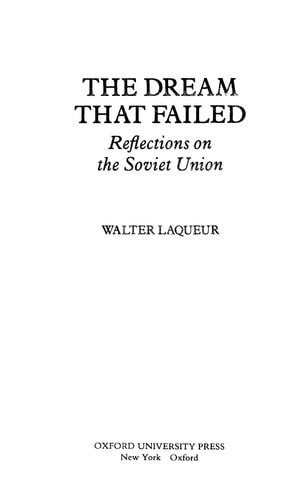
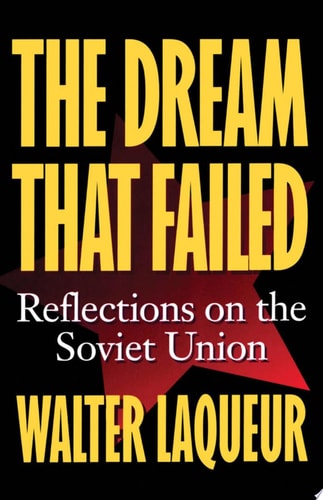
The Dream That Failed: Reflections On The Soviet Union
0
0
As an Amazon Associate and affiliate partner, Menrva Books earns from qualifying purchases. Learn more
Author Description
Walter Laqueur as been hailed as "one of our most distinguished scholars of modern European history" in the New York Times Book Review. Robert Byrnes, writing in the Journal of Modern History, called him "one of the most remarkable men in the Western world working in the field." Over a span of three decades, in books ranging from Russia and Germany to the recent Black Hundred, he has won a reputation as a major writer and a provocative thinker. Now he turns his attention to the greatest enigma of our time: the rise and fall of the Soviet Union.In Why the Soviet Union Failed, Laqueur offers an authoritative assessment of the Soviet era—from the triumph of Lenin to the fall of Gorbachev. In the last three years, decades of conventional wisdom about the U.S.S.R. have been swept away, while a flood of evidence from Russian archives demands new thinking about old assumptions. Laqueur rises to the challenge with a critical inquiry conducted on a grand scale. He shows why the Bolsheviks won the struggle for power in 1917; how they captured the commitment of a young generation of Russians; why the idealism faded as Soviet power grew; how the system ultimately collapsed; and why Western experts have been so wrong about the Communist state. Always thoughtful and incisive, Laqueur reflects on the early enthusiasm of foreign observers and Bolshevik revolutionaries—then takes a piercing look at the totalitarian nature of the Soviet Union. We see how Communist society stagnated during the 1960s and '70s, as the economy wobbled to the brink; we also see how Western observers, from academic experts to CIA analysts, made wildly optimistic estimates of Moscow's economic andpolitical strength. Just weeks before the U.S.S.R. disappeared from the earth, scholars were confidently predicting the survival of the Soviet Union. But in underscoring the rot and repression, he also notes that the Communist state did not necessarily have to fall when it did, and he examines the many factors behi
Menrva's Summary
THE THESIS
This work investigates the systemic causes behind the collapse of the Soviet Union and the failure of Western intelligence and academic communities to accurately predict its demise. Walter Laqueur, a distinguished historian of modern Europe, utilizes newly accessible archival evidence and historical analysis to challenge long-standing assumptions about the Soviet era. He constructs a critical framework that examines the trajectory of the Bolshevik state from its 1917 inception through the eventual disintegration under Gorbachev, arguing that the system's internal stagnation was frequently misread by external observers.
THE SCOPE MAP
What You Will Find
- A historical analysis of the Soviet Union from the rise of Lenin to the fall of Gorbachev.
- An examination of the systemic economic and political failures that led to stagnation during the 1960s and 1970s.
- A critique of Western intelligence and academic methodologies regarding Soviet stability.
- An assessment of the role of ideology and totalitarianism in the maintenance and eventual collapse of the Communist state.
THE AUTHORITY PERSPECTIVE
Experts recognize this text as a significant contribution to post-Cold War historiography, particularly for its focus on the failure of Western predictive models. Readers frequently note the author's incisive, critical tone and his ability to synthesize complex archival data into a coherent narrative of systemic decline.
Page Count:
0
Publication Date:
1996-01-01
Publisher:
Netlibrary, Incorporated
ISBN-10:
0198025041
ISBN-13:
9780198025047
History
Cold War
European History
Soviet Union
Communism
Community Tags
Other Editions(3)
Similar Books











Reader Comments
Share Your Thoughts
No comments yet. Be the first to share your thoughts!