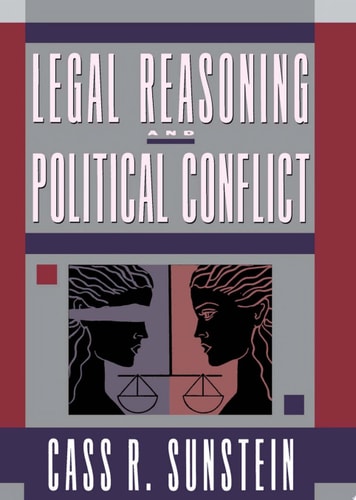
Legal Reasoning and Political Conflict
0
0
As an Amazon Associate and affiliate partner, Menrva Books earns from qualifying purchases. Learn more
Author Description
The Most Glamorous And Even Glorious Moments In A Legal System Come When A High Court Recognizes An Abstract Principle Involving, For Example, Human Liberty Or Equality. Indeed, Americans, And Not A Few Non-americans, Have Been Greatly Stirred--and Divided--by The Opinions Of The Supreme Court, Especially In The Area Of Race Relations, Where The Court Has Tried To Revolutionize American Society. But These Stirring Decisions Are Aberrations, Says Cass R. Sunstein, And Perhaps Thankfully So. In Legal Reasoning And Political Conflict, Sunstein, One Of America's Best Known Commentators On Our Legal System, Offers A Bold, New Thesis About How The Law Should Work In America, Arguing That The Courts Best Enable People To Live Together, Despite Their Diversity, By Resolving Particular Cases Without Taking Sides In Broader, More Abstract Conflicts. Sunstein Offers A Close Analysis Of The Way The Law Can Mediate Disputes In A Diverse Society, Examining How The Law Works In Practical Terms, And Showing That, To Arrive At Workable, Practical Solutions, Judges Must Avoid Broad, Abstract Reasoning. Why? For One Thing, Critics And Adversaries Who Would Never Agree On Fundamental Ideals Are Often Willing To Accept The Concrete Details Of A Particular Decision. Likewise, A Plea Bargain For Someone Caught Exceeding The Speed Limit Need Not--indeed, Must Not--delve Into Sweeping Issues Of Government Regulation And Personal Liberty. Thus Judges Purposely Limit The Scope Of Their Decisions To Avoid Reopening Large-scale Controversies. Sunstein Calls Such Actions Incompletely Theorized Agreements. In Identifying Them As The Core Feature Of Legal Reasoning--and As A Central Part Of Constitutional Thinking In America, South Africa, And Eastern Europe-- He Takes Issue With Advocates Of Comprehensive Theories And Systemization, From Robert Bork (who Champions The Original Understanding Of The Constitution) To Jeremy Bentham, The Father Of Utilitarianism, And Ronald Dworkin, Who Defends An Am
Menrva's Summary
THE THESIS
How can a legal system maintain social cohesion in a diverse society while avoiding the destabilizing effects of broad, abstract ideological conflict? Cass R. Sunstein, a prominent legal scholar, argues that the most effective judicial approach is the use of 'incompletely theorized agreements.' By focusing on the specific facts of a case rather than attempting to resolve sweeping philosophical or political disputes, judges can produce practical, workable outcomes that disparate groups are more likely to accept. This framework prioritizes incrementalism and consensus-building over the rigid application of comprehensive theories.
THE SCOPE MAP
What You Will Find
- Analysis of the 'incompletely theorized agreement' as a mechanism for judicial decision-making.
- Comparative examination of constitutional thinking across the United States, South Africa, and Eastern Europe.
- Critique of comprehensive legal theories, including originalism and utilitarianism.
- Practical methodology for resolving disputes in pluralistic societies without triggering large-scale political controversy.
THE AUTHORITY PERSPECTIVE
Legal scholars and practitioners frequently cite this work as a foundational text for understanding the mechanics of judicial restraint and incrementalism. Readers often note the academic density of the prose, which provides a rigorous challenge for those interested in the intersection of law and political philosophy.
Page Count:
240
Publication Date:
1996-01-01
Publisher:
Oxford University Press, Usa
ISBN-10:
0198026099
ISBN-13:
9780198026099
Philosophy
Jurisprudence
Law
Constitutional Law
Community Tags
Similar Books