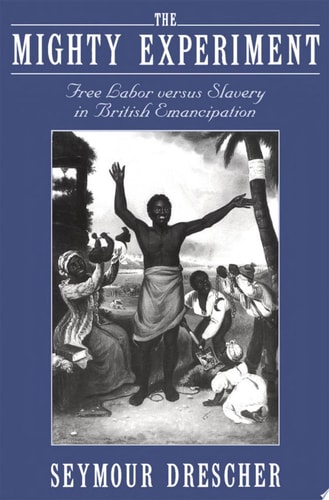
The Mighty Experiment: Free Labor versus Slavery in British Emancipation
0
0
As an Amazon Associate and affiliate partner, Menrva Books earns from qualifying purchases. Learn more
Author Description
By the mid-eighteenth century, the transatlantic slave trade was considered to be a necessary and stabilizing factor in the capitalist economies of Europe and the expanding Americas. Britain was the most influential power in this system which seemed to have the potential for unbounded growth. In 1833, the British empire became the first to liberate its slaves and then to become a driving force toward global emancipation. There has been endless debate over the reasons behind this decision. This has been portrayed on the one hand as a rational disinvestment in a foundering overseas system, and on the other as the most expensive per capita expenditure for colonial reform in modern history.In this work, Seymour Drescher argues that the plan to end British slavery, rather than being a timely escape from a failing system, was, on the contrary, the crucial element in the greatest humanitarian achievement of all time. The Mighty Experiment explores how politicians, colonial bureaucrats, pamphleteers, and scholars taking anti-slavery positions validated their claims through rational scientific arguments going beyond moral and polemical rhetoric, and how the infiltration of the social sciences into this political debate was designed to minimize agitation on both sides and provide common ground. Those at the inception of the social sciences, such as Adam Smith and Thomas Malthus, helped to develop these tools to create an argument that touched on issues of demography, racism, and political economy. By the time British emancipation became legislation, it was being treated as a massive social experiment, whose designs, many thought, had the potential to change the world.This study outlines the relationship of economic growth to moral issues in regard to slavery, and will appeal to scholars of British history, nineteenth century imperial history, the history of slavery, and those interested in the history of human rights.The Mighty Experiment was the winner of First Prize, Freder
Menrva's Summary
THE THESIS
This book investigates the complex intersection of economic theory, political reform, and humanitarian action that led to the British abolition of slavery in 1833. Seymour Drescher, a distinguished historian of slavery and abolition, challenges the notion that emancipation was merely a rational disinvestment from a failing system. Instead, he argues that the abolitionist movement utilized emerging social scientific frameworks—including demography and political economy—to transform moral imperatives into a structured, global social experiment that sought to prove the viability of free labor.
THE SCOPE MAP
What You Will Find
- An analysis of the transition from slave-based economies to free labor systems in the British Empire.
- Examination of how figures like Adam Smith and Thomas Malthus influenced the rhetoric of abolitionists.
- A study of the integration of social science methodologies into nineteenth-century political debates.
- Historical evidence regarding the economic and moral justifications used by colonial bureaucrats and pamphleteers.
THE AUTHORITY PERSPECTIVE
Historians and scholars of imperial history recognize this work as a rigorous examination of the intellectual history behind the abolitionist movement. Readers frequently note the academic density of the prose, which provides a comprehensive look at how political economy shaped the trajectory of human rights legislation.
Page Count:
320
Publication Date:
2002-01-01
Publisher:
Oxford University Press
ISBN-10:
019802536X
ISBN-13:
9780198025368
Politics
History
Categories
Kindle eBooks
Human rights
Social Science
Labor history
Kindle Store
Europe
European History
Human Resources
Slavery
World politics
British History
Community Tags
Similar Books