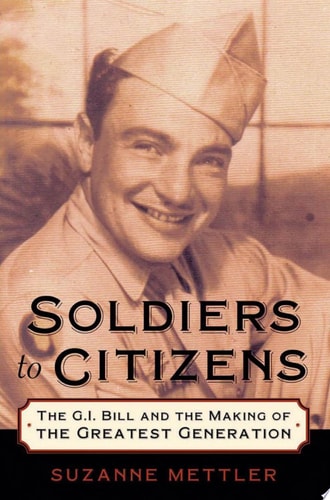
Soldiers to Citizens: The G. I. Bill and the Making of the Greatest Generation
0
0
As an Amazon Associate and affiliate partner, Menrva Books earns from qualifying purchases. Learn more
Author Description
"A hell of a gift, an opportunity." "Magnanimous." "One of the greatest advantages I ever experienced." These are the voices of World War II veterans, lavishing praise on their beloved G.I. Bill. Transcending boundaries of class and race, the Bill enabled a sizable portion of the hallowed "greatest generation" to gain vocational training or to attend college or graduate school at government expense. Its beneficiaries had grown up during the Depression, living in tenements and cold-water flats, on farms and in small towns across the nation, most of them expecting that they would one day work in the same kinds of jobs as their fathers. Then the G.I. Bill came along, and changed everything. They experienced its provisions as inclusive, fair, and tremendously effective in providing the deeply held American value of social opportunity, the chance to improve one's circumstances. They become chefs and custom builders, teachers and electricians, engineers and college professors. But the G.I. Bill fueled not only the development of the middle class: it also revitalized American democracy. Americans who came of age during World War II joined fraternal groups and neighborhood and community organizations and took part in politics at rates that made the postwar era the twentieth century's civic "golden age." Drawing on extensive interviews and surveys with hundreds of members of the "greatest generation," Suzanne Mettler finds that by treating veterans as first-class citizens and in granting advanced education, the Bill inspired them to become the active participants thanks to whom memberships in civic organizations soared and levels of political activity peaked. Mettler probes how this landmark law produced such a civic renaissance. Most fundamentally, she discovers, it communicated to veterans that government was for and about people like them, and they responded in turn. In our current age of rising inequality and declining civic engagement, Soldiers to Citizens offers critical insights into how public policy can shape the character of a nation.
Menrva's Summary
THE THESIS
This book investigates how the G.I. Bill functioned not only as an economic engine for the post-World War II middle class but as a catalyst for a surge in American civic and political participation. Suzanne Mettler, a professor of government, utilizes a combination of historical analysis, survey data, and personal interviews with veterans to argue that the legislation fostered a unique sense of citizenship. By providing tangible benefits that were perceived as fair and inclusive, the government effectively signaled to veterans that they were valued members of the national community, which in turn encouraged them to engage more deeply in democratic life.
THE SCOPE MAP
What You Will Find
- Analysis of the G.I. Bill's impact on vocational training and higher education access for World War II veterans.
- Examination of the correlation between government-provided social benefits and increased rates of civic organization membership.
- Qualitative data derived from extensive interviews and surveys with members of the "greatest generation."
- Exploration of the relationship between public policy, social mobility, and the health of American democracy.
THE AUTHORITY PERSPECTIVE
Experts recognize this work as a significant contribution to the study of American social policy and its long-term effects on political culture. Readers frequently note the clarity of the research and the compelling use of primary source interviews to illustrate broader sociological trends.
Page Count:
0
Publication Date:
2005-01-01
Publisher:
Oxford University Press, Incorporated
ISBN-10:
0198039980
ISBN-13:
9780198039983
History
Sociology
Education Policy
American History
Community Tags
Similar Books




Reader Comments
Share Your Thoughts
No comments yet. Be the first to share your thoughts!