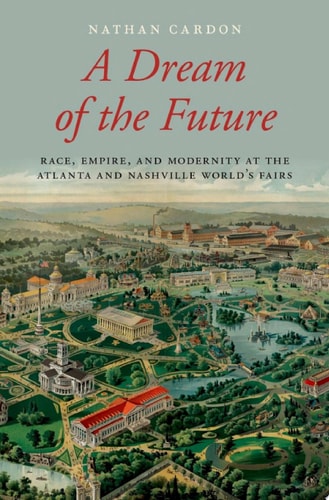
A Dream of the Future: Race, Empire, and Modernity at the Atlanta and Nashville World's Fairs
0
0
As an Amazon Associate and affiliate partner, Menrva Books earns from qualifying purchases. Learn more
Author Description
As an age of empire and industry dawned in the wake of American Civil War, Southerners grappled with what it meant to be modern. The fair expositions popular at this time allowed Southerners to explore this changing world on their own terms. On a local, national, and global stage, African Americans, New South boosters, New Women, and Civil War soldiers presented their dreams of the future to prove to the world how rapidly the South had embraced and, in the words of Henry Grady in 1890, built "from pitiful resources a great and expanding empire."Nowhere was this more apparent than at the Atlanta and Nashville world's fairs held at the close of the nineteenth century. Here, Southerners presented themselves as modern and imperial citizens ready to spread the South's culture and racial politics across the globe. Unlike the World's Columbian Exposition held in Chicago in 1893, the Southern expositions also gave African Americans an opportunity to present their own vision of modernity within the fairs' "Negro Buildings." At the fairs, southern African Americans defined themselves as both a separate race and a modern people, as "New Negroes." In Dream of the Future, Cardon explores these assertions of Southern identity and culture, critically placing them within the wider context of imperialism and industrialization.
Menrva's Summary
THE THESIS
This work investigates how Southern expositions in Atlanta and Nashville at the end of the nineteenth century served as critical sites for negotiating regional identity, racial politics, and the embrace of modernity. Nathan Cardon, a historian specializing in the American South, utilizes primary source materials from the 1895 Cotton States and International Exposition and the 1897 Tennessee Centennial Exposition to analyze how various social groups projected their visions of a modern, imperial South. The book argues that these fairs were not merely local events but were central to the South's attempt to reconcile its post-Civil War status with global ambitions and shifting racial hierarchies.
THE SCOPE MAP
What You Will Find
- Analysis of the 1895 Atlanta Cotton States and International Exposition and the 1897 Tennessee Centennial Exposition.
- Examination of the role of 'Negro Buildings' as spaces for African American self-definition and the emergence of the 'New Negro' identity.
- Exploration of the intersection between Southern boosterism, industrialization, and late-nineteenth-century imperialism.
Scope Limits
- The study focuses primarily on the Southern perspective and does not provide an exhaustive comparison to Northern or international world's fairs beyond the context of the Chicago 1893 exposition.
THE AUTHORITY PERSPECTIVE
Historians and scholars of the American South recognize this text as a significant contribution to the study of regional identity and the cultural politics of the Gilded Age. The prose is noted for its academic rigor and its ability to synthesize complex social dynamics into a coherent historical narrative.
Page Count:
192
Publication Date:
2018-01-01
Publisher:
Oxford University Press
ISBN-10:
0190274743
ISBN-13:
9780190274740
History
Sociology
American History
Exhibitions
Imperialism
Race Relations
Southern History
Southern States
Community Tags
Similar Books