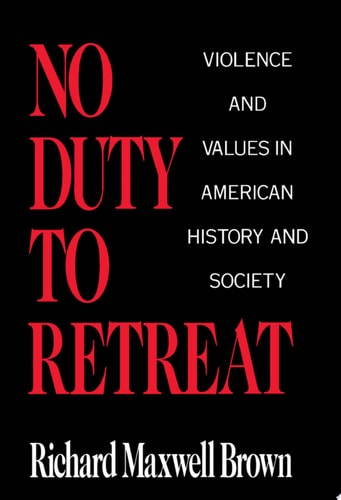
No Duty to Retreat: Violence and Values in American History and Society
0
0
As an Amazon Associate and affiliate partner, Menrva Books earns from qualifying purchases. Learn more
Author Description
In 1865, Wild Bill Hickok killed Dave Tutt in a Missouri public square in the West's first notable "walkdown." One hundred and twenty-nine years later, Bernhard Goetz shot four threatening young men in a New York subway car. Apart from gunfire, what could the two events possibly have in common? Goetz, writes Richard Maxwell Brown, was acquitted of wrongdoing in the spirit of a uniquely American view of self-defense, a view forged in frontier gunfights like Hickok's. When faced with a deadly threat, we have the right to stand our ground and fight. We have no duty to retreat. No Duty to Retreat offers an engrossing account of how this idea of self-defense emerged, focusing in particular on the gunfights of the frontier and their impact on our legal traditions. The right to stand one's ground, Brown tells us, appeared relatively recently. Under English common law, the threatened party had a legal duty to retreat "to the wall" before fighting back. But from the nineteenth century on, such authorities as Justice Oliver Wendell Holmes rejected this doctrine as unsuited to both the American mind and the age of firearms. Brown sketches the influence of frontier violence, demonstrating the tremendous impact of the famous gunmen and the prevalence of what he calls "grassroots gunfighters"--unsung men who resorted to their guns at a moment's notice. These duels, ambushes, and firefights, he writes, were more than personal vendettas: They were part of a "Western Civil War of Incorporation," pitting gunmen--usually Republicans and Unionists, who sided with the expanding banks, railroads, and businesses--against cowboys and independent farmers, who were often Democrats sympathizing with the Confederacy. Brown examines the gunfight near the O.K. Corral in this light, showing how it was a climax of tensions between Tombstone's Republican businessmen (represented by Wyatt Earp) and the county's cowboys (led by the Clantons and McLaurys). He also looks at such lesser-known battles as
Menrva's Summary
THE THESIS
This book investigates the historical origins and societal evolution of the American legal and cultural doctrine that grants individuals the right to stand their ground rather than retreat when faced with a deadly threat. Richard Maxwell Brown, a historian specializing in the American West, utilizes a combination of legal records, frontier history, and sociological analysis to argue that the American rejection of the English common law duty to retreat is deeply rooted in the violent conflicts of the nineteenth-century frontier. He posits that the normalization of gun violence during this era fundamentally reshaped American jurisprudence and the national psyche regarding self-defense.
THE SCOPE MAP
What You Will Find
- Analysis of the transition from English common law to American self-defense standards.
- Examination of the Western Civil War of Incorporation as a driver of frontier violence.
- Case studies of iconic gunfights, including the O.K. Corral and the Hickok-Tutt duel.
- Discussion of the influence of figures like Justice Oliver Wendell Holmes on legal doctrine.
Scope Limits
- The text does not provide an exhaustive survey of all state-level self-defense statutes.
- It does not focus on modern legislative debates surrounding contemporary stand-your-ground laws.
THE AUTHORITY PERSPECTIVE
Historians and legal scholars frequently cite this work for its ability to bridge the gap between frontier mythology and formal legal history. Readers often note the academic rigor of the prose, which provides a foundational understanding of how cultural violence influenced the development of American law.
Page Count:
275
Publication Date:
1992-01-01
Publisher:
Oxford University Press
ISBN-10:
019028143X
ISBN-13:
9780190281434
History
American History
United States
Sociology
Violence
Legal History
Community Tags
Similar Books