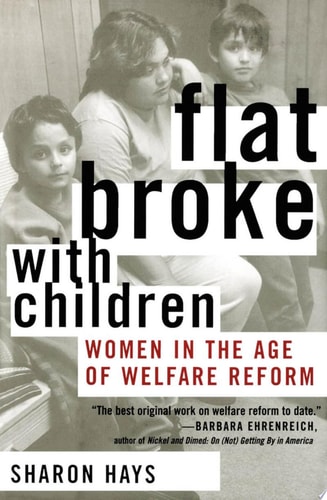
Flat Broke with Children
0
0
As an Amazon Associate and affiliate partner, Menrva Books earns from qualifying purchases. Learn more
Author Description
Hailed As A Great Success, Welfare Reform Resulted In A Dramatic Decline In The Welfare Rolls--from 4.4 Million Families In 1996 To 2 Million In 2003. But What Does This Success Look Like To The Welfare Mothers And Welfare Caseworkers Who Experienced It? In Flat Broke With Children, Sharon Hays Tells Us The Story Of Welfare Reform From Inside The Welfare Office And Inside The Lives Of Welfare Mothers, Describing The Challenges That Welfare Recipients Face In Managing Their Work, Their Families, And The Rules And Regulations Of Welfare Reform. Welfare Reform, Experienced On The Ground, Is Not A Rosy Picture. The Majority Of Adult Welfare Clients Are Mothers--over 90 Percent--and The Time Limits Imposed By Welfare Reform Throw Millions Of These Mostly Unmarried, Desperate Women Into The Labor Market, Where They Must Accept Low Wages, The Most Menial Work, The Poorest Hours, With No Benefits, And Little Flexibility. Hays Provides A Vivid Portrait Of Their Lives--debunking Many Of The Stereotypes We Have Of Welfare Recipients--but She Also Steps Back To Explore What Welfare Reform Reveals About The Meaning Of Work And Family Life In Our Society. In Particular, She Argues That An Inherent Contradiction Lies At The Heart Of Welfare Policy, Which Emphasizes Traditional Family Values Even As Its Ethic Of Personal Responsibility Requires Women To Work And Leave Their Children In Childcare Or At Home Alone All Day Long. Hays Devoted Three Years To Visiting Welfare Clients And Two Welfare Offices, One In A Medium-sized Town In The Southeast, Another In A Large, Metropolitan Area In The West. Drawing On This Hands-on Research, Flat Broke With Children Is The First Book To Explore The Impact Of Welfare Reform On Motherhood, Marriage, And Work In Women's Lives, And The First Book To Offer Us A Portrait Of How Welfare Reform Plays Out In Thousands Of Local Welfare Offices And In Millions Of Homes Across The Nation.
Menrva's Summary
THE THESIS
This book investigates the lived reality of welfare reform, questioning whether the policy's emphasis on work requirements aligns with the actual needs of mothers and the stability of family life. Sharon Hays, a sociologist, utilizes three years of ethnographic research conducted within welfare offices and the homes of recipients to analyze the systemic contradictions of the 1996 welfare reform. She argues that the policy creates an impossible tension by demanding that mothers prioritize low-wage labor while simultaneously upholding traditional family values.
THE SCOPE MAP
What You Will Find
- Ethnographic data collected from two distinct welfare offices in the Southeast and the West.
- Analysis of the impact of time limits and work requirements on single mothers.
- Qualitative evidence gathered through extensive interviews with welfare recipients and caseworkers.
- A critical examination of the societal definitions of work, motherhood, and personal responsibility.
THE AUTHORITY PERSPECTIVE
Sociologists and policy analysts frequently cite this work as a foundational ethnographic study for understanding the human impact of welfare-to-work programs. Experts highlight the text for its ability to bridge the gap between abstract policy goals and the daily struggles of low-income families.
Page Count:
304
Publication Date:
2003-01-01
Publisher:
Oxford University Press
ISBN-10:
0198030460
ISBN-13:
9780198030461
Economics
Social Science
Poverty
Sociology
Public Policy
Community Tags
Other Editions(2)

Similar Books












Reader Comments
Share Your Thoughts
No comments yet. Be the first to share your thoughts!