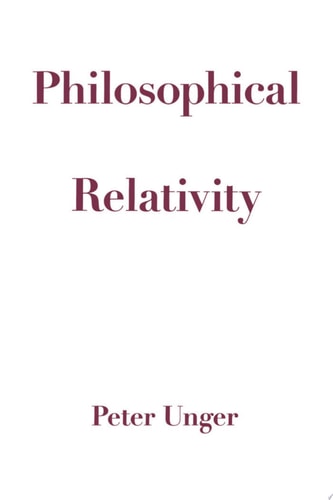
Philosophical Relativity
0
0
As an Amazon Associate and affiliate partner, Menrva Books earns from qualifying purchases. Learn more
Author Description
In this short but meaty book, Peter Unger questions the objective answers that have been given to central problems in philosophy. As Unger hypothesizes, many of these problems are unanswerable, including the problems of knowledge and scepticism, the problems of free will, and problems of causation and explanation. In each case, he argues, we arrive at one answer only relative to an assumption about the meaning of key terms, terms like "know" and like "cause," even while we arrive at an opposite answer relative to quite different assumptions, but equally arbitrary assumptions, about what the key terms mean.
Menrva's Summary
THE THESIS
This book investigates whether central philosophical problems possess objective, singular answers or if they are inherently dependent on the arbitrary definitions of key terms. Peter Unger, a prominent philosopher, examines the persistent nature of debates surrounding knowledge, skepticism, free will, and causation. He argues that the conflicting conclusions reached by various schools of thought often stem from differing, yet equally arbitrary, semantic assumptions regarding fundamental concepts. By challenging the possibility of definitive solutions, Unger proposes a framework of philosophical relativity that questions the traditional pursuit of absolute truth in these domains.
THE SCOPE MAP
What You Will Find
- Analysis of the problem of knowledge and the nature of skepticism
- Examination of the free will debate and its linguistic dependencies
- Investigation into the mechanics of causation and explanation
- A critique of semantic assumptions in analytic philosophy
THE AUTHORITY PERSPECTIVE
Philosophers and students of the discipline frequently note the dense, analytical nature of Unger's prose. Experts highlight this work as a significant contribution to meta-philosophical discourse, often citing it for its provocative stance on the limitations of traditional inquiry.
Page Count:
144
Publication Date:
2002-01-01
Publisher:
Oxford University Press
ISBN-10:
0198035446
ISBN-13:
9780198035442
Philosophy
Relativity
Metaphysics
Epistemology
Logic
Community Tags
Similar Books