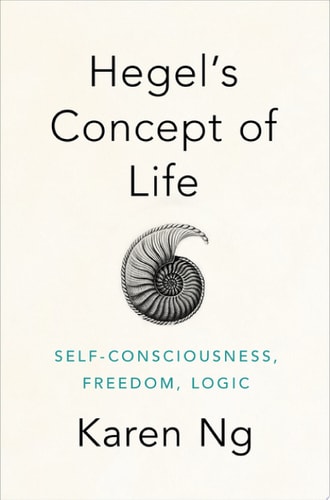
Hegel's Concept of Life: Self-Consciousness, Freedom, Logic
0
0
As an Amazon Associate and affiliate partner, Menrva Books earns from qualifying purchases. Learn more
Author Description
Karen Ng sheds new light on Hegel's famously impenetrable philosophy. She does so by offering a new interpretation of Hegel's idealism and by foregrounding Hegel's Science of Logic, revealing that Hegel's theory of reason revolves around the concept of organic life. Beginning with the influence of Kant's Critique of Judgment on Hegel, Ng argues that Hegel's key philosophical contributions concerning self-consciousness, freedom, and logic all develop around the idea of internal purposiveness, which appealed to Hegel deeply. She charts the development of the purposiveness theme in Kant's third Critique, and argues that the most important innovation from that text is the claim that the purposiveness of nature opens up and enables the operation of the power of judgment. This innovation is essential for understanding Hegel's philosophical method in the Differenzschrift (1801) and Phenomenology of Spirit (1807), where Hegel, developing lines of thought from Fichte and Schelling, argues against Kant that internal purposiveness constitutes cognition's activity, shaping its essential relation to both self and world. From there, Ng defends a new and detailed interpretation of Hegel's Science of Logic, arguing that Hegel's Subjective Logic can be understood as Hegel's version of a critique of judgment, in which life comes to be understood as opening up the possibility of intelligibility. She makes the case that Hegel's theory of judgment is modelled on reflective and teleological judgments, in which something's species or kind provides the objective context for predication. The Subjective Logic culminates in the argument that life is a primitive or original activity of judgment, one that is the necessary presupposition for the actualization of self-conscious cognition. Through bold and ambitious new arguments, Ng demonstrates the ongoing dialectic between life and self-conscious cognition, providing ground-breaking ways of understanding Hegel's philosophical system.
Menrva's Summary
THE THESIS
How does the concept of organic life serve as the foundational mechanism for Hegel's theories of self-consciousness, freedom, and logic? Karen Ng, a scholar of German Idealism, investigates the intersection of Kantian and Hegelian thought to propose that Hegel's philosophical system is anchored in the notion of internal purposiveness. By analyzing the transition from Kant's Critique of Judgment to Hegel's Science of Logic, Ng argues that life is not merely a biological category but the primary condition for the possibility of intelligibility and cognitive activity.
THE SCOPE MAP
What You Will Find
- A detailed analysis of Kant's third Critique and its influence on early German Idealism.
- A re-evaluation of Hegel's Differenzschrift and Phenomenology of Spirit.
- A systematic interpretation of Hegel's Science of Logic, specifically the Subjective Logic.
- An exploration of the relationship between teleological judgment and species-based predication.
Scope Limits
- The text does not provide a general introduction to Hegel's entire body of work.
- It does not focus on Hegel's political or social philosophy outside of the context of logic and self-consciousness.
THE AUTHORITY PERSPECTIVE
Scholars recognize this work as a significant contribution to the study of Hegel's logic, particularly for its focus on the biological and teleological dimensions of his thought. Readers frequently note the academic density of the prose, which is intended for those with a strong background in classical German philosophy.
Page Count:
333
Publication Date:
2020-01-01
Publisher:
Oxford University Press
ISBN-10:
0190947640
ISBN-13:
9780190947644
Philosophy
Metaphysics
Logic
Life
Epistemology
Logic Modern
Community Tags
Similar Books