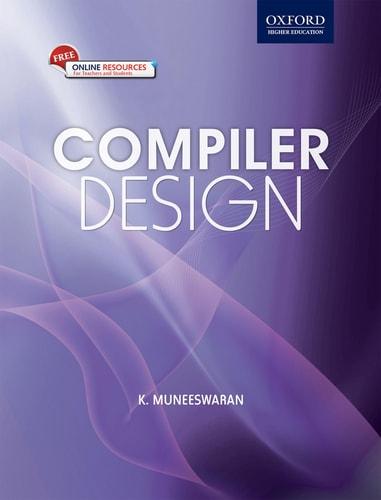
Compiler Design
0
0
As an Amazon Associate and affiliate partner, Menrva Books earns from qualifying purchases. Learn more
Author Description
The book commences with an overview of system software and briefly describes the evolution, design, and implementation of compilers. Detailed explanation of the various phases involved in the design of a compiler such as lexical analysis, syntax analysis, runtime storage organization, intermediate code generation, optimization of code, and final code generation is provided in various chapters of the book. The last chapter describes in brief all the frequently used compiler writing tools with examples and program codes.Written in a lucid manner, the book provides numerous examples, algorithms, pseudocodes and C codes in support of the text. Chapter-end exercises, appendices and the companion CD are provided to help readers revise and practice the learnt concepts.
Menrva's Summary
THE THESIS
This text investigates the systematic architecture and implementation of compilers, addressing the core question of how high-level programming languages are translated into machine-executable code. K. Muneeswaran provides a structured framework that guides the reader through the lifecycle of compiler construction, from initial lexical analysis to final code optimization. The book utilizes a combination of theoretical algorithms, pseudocode, and practical C programming examples to bridge the gap between abstract computer science concepts and tangible software engineering applications.
THE SCOPE MAP
What You Will Find
- Comprehensive breakdown of compiler phases including lexical analysis, syntax analysis, and intermediate code generation
- Technical exploration of runtime storage organization and code optimization techniques
- Practical implementation examples using C code and various compiler writing tools
- Pedagogical support through chapter-end exercises, appendices, and supplementary digital materials
THE AUTHORITY PERSPECTIVE
This book is recognized as a practical resource for students and practitioners seeking a clear, step-by-step introduction to compiler construction. Experts highlight the inclusion of C code and pseudocode as a significant aid for those who prefer learning through direct application rather than purely theoretical study.
Page Count:
660
Publication Date:
2013-03-18
Publisher:
Oxford University Press
ISBN-10:
0198066643
ISBN-13:
9780198066644
Computer Science
Computer programs
Software Engineering
textbook
Programming
Community Tags
Similar Books