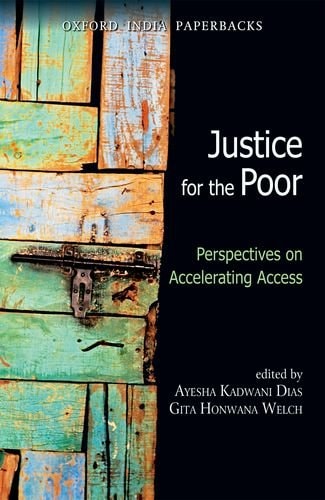
Justice for the Poor: Perspectives on Accelerating Access
0
0
As an Amazon Associate and affiliate partner, Menrva Books earns from qualifying purchases. Learn more
Author Description
Product Description One of the most significant contemporary lessons from development work around the world is that national judicial systems-and access to them-are of critical importance in the struggle against poverty. Contending that legal strategies play an important role in protection of human rights, thisbook discusses important global issues related to human rights including human justice and security. It examines institutional strategies that aim at accelerating human justice delivery, and securing civil, political, socio-economic, and cultural rights. The work also puts in perspective a number ofpractical recommendations for justice programming and development. Establishing the essential link between poverty reduction and justice programming, it clarifies conceptual issues related to justice from the perspective of the weak and marginalized.The essays in the volume address crucial issues such as practical and effective strategies for securing access to justice for the poor and means for evaluating justice programming from a results-based perspective. Further it focuses on the interplay between poverty, good governance, andaccountability instrumental in realizing the Millennium Development Goals, and ensuring participation and non-discrimination in developmental decision-making. Addressing important issues such as access to justice in plural legal systems, public interest litigation, the effects of globalization, anddenial of women's rights, the book examines judicial reform initiatives. About the Author Ayesha Kadwani Dias is Consultant to the Democratic Governance Group, UNDP, New York. Gita Honwana Welch is UNDP Country Director for Angola.
Menrva's Summary
THE THESIS
This volume investigates the critical nexus between national judicial systems and the reduction of poverty, arguing that legal empowerment is a prerequisite for human rights protection. The authors, Ayesha Kadwani Dias and Gita Honwana Welch, draw upon their extensive experience with the United Nations Development Programme to synthesize institutional strategies for justice delivery. They present a framework that prioritizes the needs of marginalized populations, linking effective legal access to the broader realization of socio-economic and political rights.
THE SCOPE MAP
What You Will Find
- Analysis of justice programming within plural legal systems and the impact of globalization.
- Methodologies for evaluating justice initiatives from a results-based perspective.
- Case studies and conceptual frameworks regarding public interest litigation and human rights.
- Examination of the interplay between good governance, accountability, and the Millennium Development Goals.
THE AUTHORITY PERSPECTIVE
Experts identify this work as a significant resource for development practitioners and policymakers focused on institutional reform. Readers frequently note the practical orientation of the essays, which bridge the gap between abstract human rights theory and the operational realities of justice programming.
Page Count:
678
Publication Date:
2012-01-01
Publisher:
Oxford University Press
ISBN-10:
0198077211
ISBN-13:
9780198077213
Sociology
Poverty
Human rights
Law Reform
Law
Governance
Justice Administration of
Community Tags
Similar Books