Bharathipura
0
0
As an Amazon Associate and affiliate partner, Menrva Books earns from qualifying purchases. Learn more
Author Description
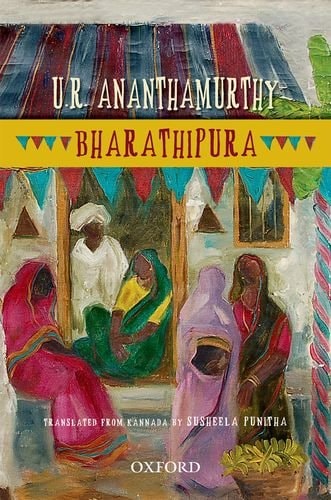
First published in 1973, 'Bharathipura' reveals U.R. Ananthamurthy's (b.1932) lifelong preoccupation with moving beyond caste and class interests in a modern society.Set in contemporary India, 'Bharathipura' revolves around the life of an 'enlightened' modern Indian, Jagannatha, who in order to get rid of his personal burdens commits a 'scandalous' act. His attempt to take 'untouchables' into the local Manjunatha temple exposes the complexities of the caste system and the myth of social justice in modern India. Further, the novel brings to light how the contemporary world recreates and reconstructs the past to protect hierarchical structures prevalent across societies, and also portrays the altering destinies of individuals and communities.In Susheela Punitha's hands, the translation retains the cultural and linguistic ambience of the Kannada society. The detailed Introduction by N. Manu Chakravarthy sets the work in the context of twentieth-century India. The in-depth interview of the author by Chakravarthy, a special feature of this volume, opens a window to Ananthamurthy's art and worldview.
Menrva's Summary
THE PULSE
Jagannatha, a modern man seeking to shed his personal burdens, initiates a social upheaval by attempting to lead untouchables into a restricted temple. Driven by a desire to challenge the rigid caste hierarchies of his community, Jagannatha acts as an agent of change whose individual rebellion triggers a broader societal crisis. The narrative explores the friction between his progressive ideals and the deeply entrenched traditionalism of his environment. Through a lens of social realism, the story examines the logical and physical constraints of a society that actively reconstructs its past to maintain existing power structures.
INSIDE THE PAGES
- Exploration of the intersection between individual morality and collective social norms.
- Detailed examination of the caste system within a contemporary Indian setting.
- Use of the temple as a central symbol of exclusion and institutional power.
- Analysis of how historical narratives are manipulated to preserve current hierarchies.
- Portrayal of the shifting destinies of marginalized communities versus the elite.
- Inclusion of a scholarly introduction providing twentieth-century historical context.
- Features an in-depth interview with the author regarding his artistic philosophy.
- Translation that preserves the specific cultural and linguistic nuances of Kannada society.
THE COLLECTIVE ECHO
Readers and critics frequently discuss the novel as a profound examination of the limitations of individual enlightenment in the face of systemic oppression. Discussion often centers on the protagonist's complex motivations and whether his actions represent genuine altruism or a self-serving attempt to resolve personal guilt. The pacing is noted for its deliberate, reflective quality, which allows the author to dissect the psychological and social ramifications of the central conflict. Many highlight the effectiveness of the temple setting as a microcosm for the broader tensions within Indian society. The work is widely regarded as a significant contribution to post-colonial literature that avoids simplistic resolutions to the problems it presents.
Page Count:
312
Publication Date:
2011-04-25
Publisher:
Oxford University Press
ISBN-10:
0198070489
ISBN-13:
9780198070481
Literary Fiction
Fiction
India
Political fiction
Social Commentary
Indian