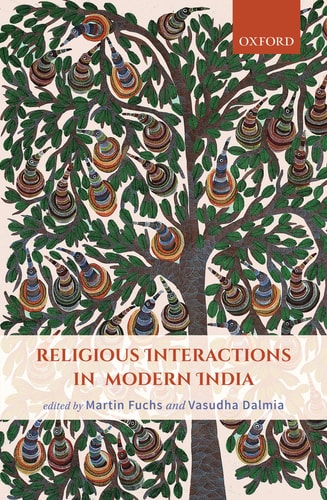
Religious Interactions in Modern India
0
0
As an Amazon Associate and affiliate partner, Menrva Books earns from qualifying purchases. Learn more
Author Description
Religions in South Asia have tended to be studied in blocks, whether in the various monolithic traditions in which they are now regarded, thus Hindu, Muslim, Buddhist, Sikh, Jain, Christian, or indeed in temporal blocks: ancient, medieval, modern. This volume seeks to look at relationships both within and between religions. It explores the diversity and the multiplicity within each tradition, the historical links between the various traditions which have crisscrossed the monoliths, but also the specific forms of their co-existence with each other, whether in accord or in antagonism. It views the interaction between 'reformed' and non-reformed branches within each of the modern monoliths, as for instance the Arya Samaj and the Sanatani positions within Hinduism. Its second major concern is to look for grounds shared in the process of modernizing. Though there has been much research to date on religious reform movements, there has been less concern with investigating and analyzing developments across the religious boundaries that so sharply divide Hinduism, Sikhism, Buddhism and Islam from each other today, and all of these from Christianity. And finally, it also looks at the changing social and political frames of reference shared by both religious and secularist strands of thought. The 'religions' targeted include Hindu discourses (Brahmo, Arya, Sanatana, and various traditional formations, the Aryan/Dravidian divide), Buddhist, Jain, Sikh and Islamic traditions, and Indian Christianity.
Menrva's Summary
THE THESIS
This volume investigates the complex, often overlooked interactions and shared modernizing processes occurring between and within diverse religious traditions in contemporary India. The authors, Martin Fuchs and Vasudha Dalmia, challenge the tendency to study religions as monolithic, isolated blocks by examining the historical and social links that bridge these traditions. Through a rigorous analytical framework, they explore how various religious groups navigate coexistence, antagonism, and the pressures of modernization within the shifting political landscape of the region.
THE SCOPE MAP
What You Will Find
- Comparative analysis of Hindu, Muslim, Buddhist, Sikh, Jain, and Christian traditions in India.
- Examination of internal reform movements such as the Arya Samaj and Sanatani positions.
- Investigation of shared social and political frames of reference between religious and secularist thought.
- Historical and sociological study of the boundaries and intersections between religious identities.
THE AUTHORITY PERSPECTIVE
Experts recognize this work as a significant contribution to South Asian studies for its refusal to treat religious traditions as static or isolated entities. Scholars frequently cite the text for its nuanced approach to the intersection of religious reform and modernizing social structures.
Page Count:
472
Publication Date:
2019-01-01
Publisher:
Oxford University Press
ISBN-10:
0198081685
ISBN-13:
9780198081685
History
Religion
India
India religion
Sociology
Religions
Community Tags
Similar Books