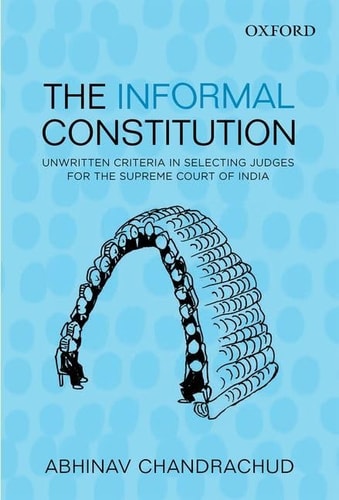
The Informal Constitution: Unwritten Criteria in Selecting Judges for the Supreme Court of India
0
0
As an Amazon Associate and affiliate partner, Menrva Books earns from qualifying purchases. Learn more
Author Description
Between 1950 and 2009, 189 judges (including 37 Chief Justices) served on the Supreme Court of India, dubbed one of the world's most powerful courts. Not enough is known of who these judges were and the criteria that were used to select them for the court, especially of those who served on the court in relatively recent times. Broadly speaking, the Indian constitution formally provides that three types of individuals can be appointed to the Supreme Court: (1) High Court judges of five years' standing, (2) High Court lawyers of ten years' standing, or (3) "distinguished jurists", i.e. law professors or others. However, this says very little, perhaps nothing, about the kind of candidates that are selected for appointment to the court. Informal norms have evolved over a period of sixty years which co-exist alongside formal constitutional rules-norms that govern who will be considered fit and eligible for appointment to the Supreme Court of India. In this study, the author has aimed to quantitatively and qualitatively demonstrate that three informal eligibility criteria in particular are used to select judges for the Supreme Court of India, i.e. criteria that have not been formally specified in any constitutional document: (1) a judge should be of the age of 55 or above at the time he is considered for appointment to the Supreme Court, (2) he should be a senior High Court judge or, especially over the last twenty years, a High Court Chief Justice, (3) judges should reflect the geographic (and demographic) diversity of India, i.e. judges are selected for the Supreme Court by taking into account the state or region they belong to, and whether they belong to non-traditional backgrounds, i.e. in terms of religion, caste, or gender.
Menrva's Summary
THE THESIS
This book investigates the unwritten, informal criteria that have historically governed the selection of judges for the Supreme Court of India, despite the formal constitutional framework. Abhinav Chandrachud, a legal scholar, utilizes a combination of quantitative data and qualitative analysis to examine the appointments of 189 judges between 1950 and 2009. The author argues that while the Constitution provides broad eligibility requirements, a set of evolved, informal norms—specifically regarding age, seniority, and geographic or demographic representation—has dictated the actual composition of the court for over sixty years.
THE SCOPE MAP
What You Will Find
- A comprehensive analysis of judicial appointments to the Supreme Court of India from 1950 to 2009.
- Examination of the three primary informal criteria: age thresholds, seniority as High Court Chief Justices, and regional/demographic diversity.
- A critique of the gap between formal constitutional text and the practical reality of judicial selection.
- Data-driven insights into the professional backgrounds of 189 judges and 37 Chief Justices.
THE AUTHORITY PERSPECTIVE
Legal scholars and practitioners recognize this work as a significant contribution to the study of Indian constitutional law and judicial administration. Readers frequently note the clarity of the author's research methodology in exposing the opaque processes behind high-level judicial appointments.
Page Count:
336
Publication Date:
2014-07-01
Publisher:
Oxford University Press
ISBN-10:
0198098561
ISBN-13:
9780198098560
History
Judges
Kindle Store
Categories
Kindle eBooks
India
Law
Supreme Court
Community Tags
Other Editions(2)
Similar Books




Reader Comments
Share Your Thoughts
No comments yet. Be the first to share your thoughts!