Boiled Beans on Toast: A Play
0
0
As an Amazon Associate and affiliate partner, Menrva Books earns from qualifying purchases. Learn more
Author Description
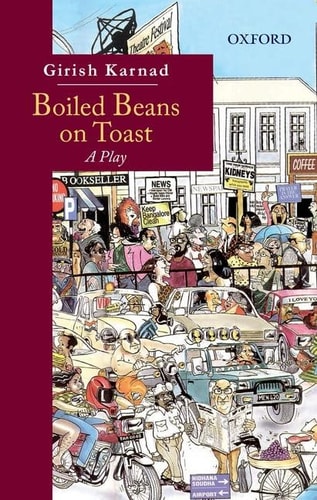
One of the finest playwrights of our time, Girish Karnad's plays present a critical sense of history, myth, and time. This new play by Karnad has a reference to the founding lore of Bangalore, in which an 11th century king was saved by an old woman who offered him boiled beans. The grateful king desired to name the spot 'Bendakalooru', the place of boiled beans, which would symbolize hospitality and welcome for a weary traveller. However, over the period of time the place has emerged as Bangalore, India's 'Silicon Valley'. The play makes this impersonal city and its humongous growth in the last two decades its subject. Portraying the story of a cross section of those who live in the city-well-off housewives and their maid servants with hidden and complicated lives; lower middle class strugglers desperate to climb the corporate ladder; privileged rich kids rebelling against their fathers' money-this play is a direct and realistic gaze at contemporary India.
Menrva's Summary
THE PULSE
The rapid, impersonal expansion of Bangalore serves as the backdrop for a series of interconnected lives struggling to find meaning within a transforming urban landscape. The play examines the friction between the city's historical identity as a site of hospitality and its modern reality as a globalized corporate hub. Through a series of vignettes, Karnad explores the lives of diverse residents, including domestic workers, corporate strivers, and disillusioned youth. The narrative framework utilizes a multi-perspective approach to contrast the private, hidden complexities of individuals against the overwhelming, monolithic growth of the city itself.
INSIDE THE PAGES
- Exploration of the socio-economic divide between the wealthy and the working class
- Integration of historical myth as a thematic counterpoint to modern urban development
- Character-driven vignettes highlighting the isolation of city life
- Examination of corporate culture and the pressures of upward mobility
- Critique of generational conflict between privileged youth and their parents
- Realistic dialogue capturing the nuances of contemporary Indian social dynamics
- Use of the city of Bangalore as a central, active character in the narrative
- Focus on the hidden, private lives of domestic staff and marginalized residents
THE COLLECTIVE ECHO
Readers and critics frequently highlight Karnad's ability to distill the chaotic essence of a rapidly modernizing city into a coherent dramatic structure. Discussion often centers on the play's effective use of the 'boiled beans' myth to underscore the irony of Bangalore's current status as a cold, corporate center. Observers note that the play balances individual character arcs with a broader sociological critique of urban expansion. The work is often praised for its refusal to romanticize the city, opting instead for a clinical and direct gaze at the human cost of economic progress. Many appreciate how the play gives voice to the disparate social strata that coexist within the same physical space.
Page Count:
96
Publication Date:
2014-04-01
Publisher:
Oxford University Press
ISBN-10:
019809860X
ISBN-13:
9780198098607
Drama
Contemporary
Social Commentary
Urban Life
Indian
Plays
Community Tags
Similar Books