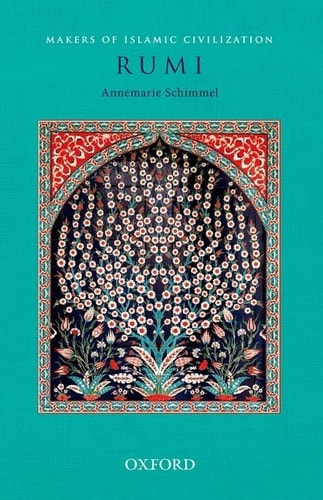
Rumi: Makers of Islamic Civilization
0
0
As an Amazon Associate and affiliate partner, Menrva Books earns from qualifying purchases. Learn more
Author Description
Jalaluddin Rumi (1207-1273) is the most famous exponent of the mystical tradition in Islam and venerated as "Mevlana," "our master." The still flourishing Mevlevi order of dervishes, famous for their ecstatic music and dance, was organized by his eldest son on the basis of Rumi's teaching and practice. He spent most of his life in Konya in Rum (modern Anatolia), whence the name "Rumi." His longest work, the Mathnavi, has held its reputation in the eastern lands of the Islamic world as the most recited and venerated text after the Qur'an. Echoes of the Muslim Scripture, and traces of Rumi's education as a traditional Muslim jurist or faqih, are apparent throughout his writings. The resurgence of interest in Rumi in the West has evolved into a cult, especially on American college campuses. As Schimmel explains, this cult does not do justice to the profound spiritual passion and insights of the Mathnavi and Rumi's Divan. In this concise, readable essay, she sketches the major landmarks in Rumi's life and the influences on it, the religious and cultural background of his poetic Sufism, the dominant strands of imagery and the range of tone and anecdote that animate his spiritual world. She explains why Rumi, as poet and mystic, must be understood in the Persian literary and the Islamic religious traditions to which he belonged. It is through those traditions that he experienced and expressed the Divine Love that the peoples of all faith traditions immediately recognize and affirm. The closing chapters review recent scholarship and translations of Rumi's works, in West and East, and answer the question "What does Rumi mean to us in the modern world?"
Menrva's Summary
THE THESIS
This work investigates the life and spiritual legacy of Jalaluddin Rumi, questioning how modern Western interpretations of his work often obscure his foundational identity as a traditional Muslim mystic and jurist. Annemarie Schimmel, a renowned scholar of Islamic mysticism, utilizes her deep expertise in Persian literature and Sufi tradition to contextualize Rumi within the 13th-century Anatolian landscape. She argues that to truly grasp the depth of Rumi's spiritual insights, one must move beyond contemporary pop-culture appropriations and engage with the specific Islamic and Persian frameworks that shaped his poetry and philosophy.
THE SCOPE MAP
What You Will Find
- A biographical overview of Rumi's life in 13th-century Konya and his education as a faqih.
- An analysis of the Mathnavi and Divan within the context of Persian literary traditions.
- A critical examination of the modern Western "cult" of Rumi compared to his historical religious significance.
- A review of contemporary scholarship and translation trends regarding Rumi's spiritual writings.
THE AUTHORITY PERSPECTIVE
Scholars and students of Islamic history view this text as a vital corrective to the decontextualized popularization of Rumi's poetry. Readers frequently note that Schimmel's prose is both academically rigorous and accessible, making it an essential resource for those seeking to understand the intersection of Sufi mysticism and Islamic theology.
Page Count:
136
Publication Date:
2014-06-01
Publisher:
Oxford University Press
ISBN-10:
0198099819
ISBN-13:
9780198099819
History
Religion
Philosophy
Biography
Islamic Studies
Criticism history
Sufism
Literary Criticism
Community Tags
Similar Books