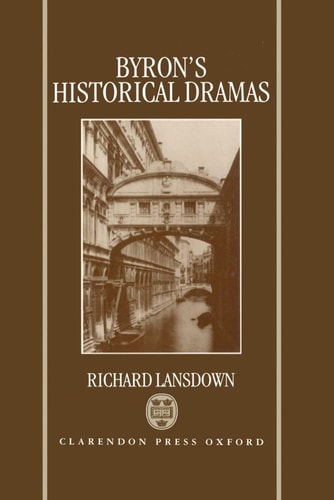
Byron's Historical Dramas
0
0
As an Amazon Associate and affiliate partner, Menrva Books earns from qualifying purchases. Learn more
Author Description
Byron's poetic reputation is currently founded on his comic epic Don Juan and its cognates Beppo and The Vision of Judgement. Works outside this group are still regarded with some uncertainty. This study demonstrates that some of Byron's most deeply held critical and political convictions--but also certain aspects of his experience over which he had comparatively little conscious control--found expression in his historical dramas of 1820-1821: Marino Faliero, Sardanapalus, and The Two Foscari. In these plays Byron responds with the fullest degree of imaginative intelligence to his work on the management subcommittee at the Theatre Royal, Drury Lane, the background to which is given its most extensive treatment yet; to his involvement with the Italian nationalist movement; to his advocacy of neo-classical dramatic form and above all to his understanding of Shakespeare and of Shakespeare's reputation among Romantic critics. Lansdown illuminates a fascinating but overlooked aspect of Byron's oeuvre in which the literary, the historical, and the political are closely intertwined.
Menrva's Summary
THE THESIS
This study investigates the significance of Lord Byron's historical dramas written between 1820 and 1821, arguing that they serve as a vital repository for his political convictions and personal experiences. Richard Lansdown, a scholar of Romantic literature, examines the plays Marino Faliero, Sardanapalus, and The Two Foscari to reveal how they synthesize Byron's theatrical management experience, his engagement with Italian nationalism, and his complex relationship with Shakespearean dramatic tradition. By situating these works within their specific historical and biographical contexts, the author challenges the critical tendency to prioritize Byron's comic epics over his dramatic output.
THE SCOPE MAP
What You Will Find
- Detailed analysis of the historical dramas Marino Faliero, Sardanapalus, and The Two Foscari.
- Extensive documentation regarding Byron's tenure on the management subcommittee at the Theatre Royal, Drury Lane.
- Exploration of the influence of neo-classical dramatic forms and Romantic-era Shakespearean criticism.
- Examination of the intersection between Byron's political involvement in the Italian nationalist movement and his creative output.
THE AUTHORITY PERSPECTIVE
Scholars and critics recognize this work as a significant contribution to the re-evaluation of Byron's dramatic canon. The text is noted for its rigorous archival research and its ability to bridge the gap between biographical detail and literary analysis.
Page Count:
272
Publication Date:
1992-07-09
Publisher:
Clarendon Press
ISBN-10:
0198112521
ISBN-13:
9780198112525
Poetry
Biography
Drama
History
Criticism history
Literary Criticism
Community Tags
Similar Books