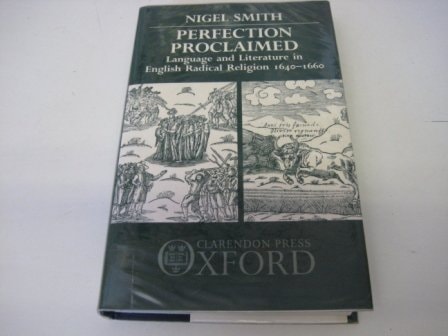
Perfection Proclaimed: Language and Literature in English Radical Religion 1640-1660
0
0
As an Amazon Associate and affiliate partner, Menrva Books earns from qualifying purchases. Learn more
Author Description
This compelling study traces the development of radical religious literature between 1640 and 1660 and offers a reorientation of how the sects are seen to rest in history. Introducing new evidence on religious individuals and groups, Smith argues that there are continuities between radicalism and the rest of mid-17th-century English society. He explores in detail such topics as the experiential and prophetic narratives in the "gathered churches," the centrality of the recounting of dreams and visions especially in the writings of women prophets, the reaction of radical Puritans to mystical and occult writings, and the theory and practice of radical religious language.
Menrva's Summary
THE THESIS
This study investigates the intersection of radical religious expression and literary development in England during the mid-17th century. Nigel R. M. Smith, a scholar of early modern literature and history, utilizes a combination of archival research and textual analysis to challenge traditional historiography regarding religious sects. He argues that radical religious groups were not isolated phenomena but were deeply integrated into the broader social and cultural fabric of the period, utilizing specific linguistic and prophetic modes to articulate their beliefs.
THE SCOPE MAP
What You Will Find
- Analysis of radical religious literature produced between 1640 and 1660.
- Examination of prophetic and experiential narratives within gathered churches.
- Investigation into the role of women prophets and the documentation of dreams and visions.
- Discussion of the influence of mystical and occult writings on radical Puritan thought.
THE AUTHORITY PERSPECTIVE
Scholars frequently cite this work as a foundational text for understanding the linguistic strategies of 17th-century religious dissenters. Experts highlight the author's ability to bridge the gap between historical religious movements and literary theory, noting the academic rigor of the prose.
Page Count:
416
Publication Date:
1989-03-09
Publisher:
Oxford University Press
ISBN-10:
0198128797
ISBN-13:
9780198128793
Religion
History
British History
Literary Criticism
Community Tags
Similar Books