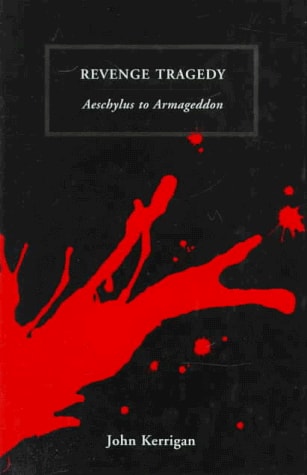
Revenge Tragedy: Aeschylus to Armageddon
0
0
As an Amazon Associate and affiliate partner, Menrva Books earns from qualifying purchases. Learn more
Author Description
Revenge has long been a central theme in Western culture. From Homer to Nietzsche, from St. Paul to Sylvia Plath, major writers have been fascinated by its emotional intensity and by the questions it raises about the nature of justice, violence, sexuality, and death. John Kerrigan employs both wide-ranging historical analysis and subtle attention to individual texts to explore the culture of vengeance in several languages and genres. Thus, he shows how evolving attitudes to retribution have shaped and reconstituted tragedy in the West and elucidates the remarkable capacity of this ancient theme to generate innovative works of art. Although this book is a literary study, it makes use of anthropology, social theory, and moral philosophy. As a result, it will be of interest to students in a variety of disciplines, as well as to the general reader.
Menrva's Summary
THE THESIS
This book investigates how the theme of revenge has functioned as a primary driver for the evolution of Western tragedy from classical antiquity to modern literature. John Kerrigan, a scholar of literature, utilizes a multidisciplinary approach that integrates historical analysis with insights from anthropology, social theory, and moral philosophy. By examining a broad spectrum of texts across multiple languages, he argues that the shifting cultural perceptions of retribution have fundamentally shaped the development of tragic art.
THE SCOPE MAP
What You Will Find
- A historical survey of revenge as a literary motif from Homeric epics to modern works.
- Analysis of the intersection between vengeance and concepts of justice, violence, and sexuality.
- Application of anthropological and philosophical frameworks to interpret dramatic texts.
- Comparative study of how different linguistic and cultural traditions handle the theme of retribution.
THE AUTHORITY PERSPECTIVE
Scholars and students frequently cite this work as a comprehensive resource for understanding the intellectual history of vengeance in Western drama. Readers often note the academic density of the prose, which balances rigorous textual analysis with broad theoretical inquiries.
Page Count:
432
Publication Date:
1996-07-25
Publisher:
Oxford University Press
ISBN-10:
0198121865
ISBN-13:
9780198121862
History
Philosophy
Drama
Literary Criticism
In literature
Tragedy