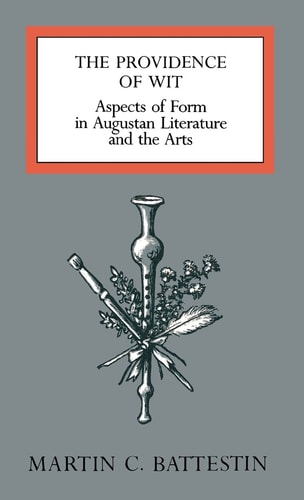
The Providence of Wit: Aspects of Form in Augustan Literature and the Arts
0
0
As an Amazon Associate and affiliate partner, Menrva Books earns from qualifying purchases. Learn more
Author Description
By exploring the relationship between the idea of Nature and the idea of Art in the period from 1660-1760, this study attempts to account for the distinctive quality of the 'Augustan mode' in literature in arts. Before what Pope envisioned as the apocalypse of modernism occurred, artists and aestheticians shared the faith of Newton and the divines in providential order, and, refining the neoclassical doctrine of mimesis, they expressed that faith in theory and practice. In shaping his own ideal forms, the Augustan artist took as paradigm the fiat of Genesis. Showing that theories of 'pure form' in the period rest upon the mutually dependent assumptions of ethnology and aesthetics, Professor Battestin first discusses the ways in which ideas of Nature's harmony, symmetry, and variety affected the doctrine of mimesis in the abstract arts of music, architecture, and gardening. Against the background he next examines the idea of Art and the relationship between form and meaning in the poetry of Pope and Gay and the fiction of Fielding and Godlsmith. THe final chapter, focusing on the deliberate violation of these formal principles in A Tale of Tub and Tristram Shandy, distinguishes between the Augustan and Modern modes by contrasting Swift's implicit acceptance of the ideals of his age with Sterne's sense that they are no logner relevant either to life or to art.
Menrva's Summary
THE THESIS
This study investigates how the Augustan period's belief in a providential, divinely ordered universe shaped the aesthetic and formal principles of its literature and arts between 1660 and 1760. Professor Martin C. Battestin, a scholar of 18th-century literature, utilizes a framework that connects the philosophical assumptions of Newton and contemporary theologians to the artistic doctrine of mimesis. He argues that artists of this era viewed their creative process as a reflection of the divine fiat, seeking to mirror the harmony and symmetry of Nature in their own works.
THE SCOPE MAP
What You Will Find
- Analysis of the relationship between the concepts of Nature and Art in the 17th and 18th centuries.
- Examination of how symmetry, harmony, and variety influenced the abstract arts of music, architecture, and gardening.
- Critical readings of poetry by Alexander Pope and John Gay, alongside the fiction of Henry Fielding and Oliver Goldsmith.
- A comparative study of formal subversion in Jonathan Swift's A Tale of a Tub and Laurence Sterne's Tristram Shandy.
THE AUTHORITY PERSPECTIVE
Scholars frequently cite this work as a significant contribution to the understanding of neoclassical aesthetics and the transition toward modernism. Readers often note the academic density of the prose, which requires a strong familiarity with 18th-century intellectual history to fully appreciate the author's arguments.
Page Count:
446
Publication Date:
1983-10-16
Publisher:
University of Virginia Press
ISBN-10:
0198120524
ISBN-13:
9780198120520
History
Philosophy
Art History
Literary Criticism
Community Tags
Similar Books