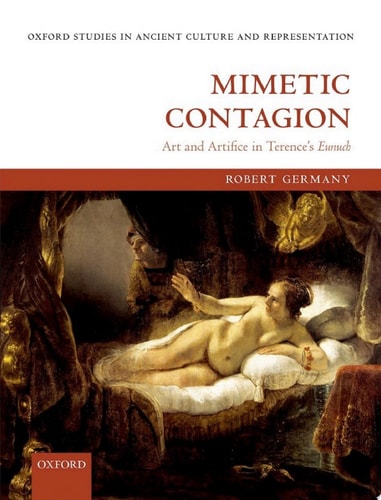
Mimetic Contagion: Art and Artifice in Terence's Eunuch
0
0
As an Amazon Associate and affiliate partner, Menrva Books earns from qualifying purchases. Learn more
Author Description
When we are confronted with a work of art, what is its effect on us? In contrast to post-Enlightenment conceptions, which tend to restrict themselves to aesthetic or discursive responses, the ancient Greeks and Romans often conceived works of art as having a more dynamic effect on their viewers, inspiring them to direct imitation of what they saw represented. This notion of 'mimetic contagion' was a persistent and widespread mode of framing response to art across the ancient world, discernible in both popular and elevated cultural forms, yet deployed differently in various historical contexts; it is only under the specificity of a particular cultural moment's concerns that it becomes most useful as a lens for understanding how that culture is attempting to negotiate the problems of representation. After framing the phenomenon in terms general enough to be applicable across many periods, literary genres, and artistic media, this volume takes a particular literary work, Terence's Eunuch, as a starting point, both as a vivid example of this extensive pattern, and as a case study situating use of the motif within the peculiarities of a particular historical moment, in this case mid-second-century BC Rome and its anxieties about the power of art. One of the features of mimetic contagion frequently noted in this study is its capacity to render the operation of a particular work of art an emblem for the effect of representation more generally, and this is certainly the case in the Eunuch, whereby the painting at the centre of the play functions as a metatheatrical figure for the dynamics of mimesis throughout, illustrating how the concept may function as the key to a particular literary work. Although mimetic contagion is only one available Greco-Roman strategy for understanding the power of art, by offering an extended reading of a single work of literature through this lens, this volume demonstrates what ramifications closer attention to it might have for modern readers
Menrva's Summary
THE THESIS
This volume investigates the concept of 'mimetic contagion' to determine how ancient Roman culture perceived the power of art to influence and transform its viewers. Robert Germany, a scholar of classical literature, utilizes historical and literary analysis to argue that ancient audiences viewed art not merely as aesthetic objects, but as dynamic forces capable of inciting direct imitation. By examining the socio-political anxieties of mid-second-century BC Rome, the author demonstrates how this phenomenon served as a critical framework for negotiating the complexities of representation.
THE SCOPE MAP
What You Will Find
- A theoretical framework defining mimetic contagion across various ancient media and genres.
- A detailed case study of Terence's play, 'Eunuch', focusing on its central painting as a metatheatrical device.
- Analysis of Roman cultural anxieties regarding the influence of Greek art and performance.
Scope Limits
- The study does not provide an exhaustive history of all Greco-Roman theories of art.
- The analysis is primarily focused on the specific context of mid-second-century BC Rome rather than the entire span of antiquity.
THE AUTHORITY PERSPECTIVE
Scholars recognize this work as a nuanced contribution to the study of ancient reception theory and Roman theatrical practice. Readers frequently note the academic density of the prose, which serves as a rigorous examination of how classical texts engage with the power of visual representation.
Page Count:
240
Publication Date:
2016-01-01
Publisher:
OUP Oxford
ISBN-10:
0191091111
ISBN-13:
9780191091117
Philosophy
History
Art History
Terence
Literary Criticism
In literature
Ancient History
Community Tags
Other Editions(2)
Similar Books


Reader Comments
Share Your Thoughts
No comments yet. Be the first to share your thoughts!