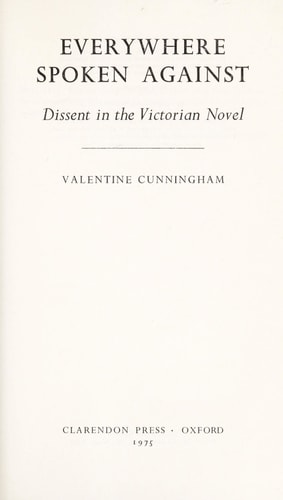
Everywhere Spoken Against: Dissent in the Victorian Novel
0
0
As an Amazon Associate and affiliate partner, Menrva Books earns from qualifying purchases. Learn more
Author Description
This Study Of Victorian Fiction's Response To Religious Nonconformity Focuses Particularly On The Ways Dissent Is Presented In The Novels Of The Brontes, Mrs. Gaskell, George Eliot, Dickens, Mrs. Oliphant, And Mark Rutherford. As Well As Scrutinizing The Causes And Effects Of Their Varying Responses To Dissent, The Author Explores The Wider Background Of Dissent In The Period- Its Spread And Location, Its Links With The City And With Radicalism, And Its Attitudes To Fiction. --dust Jacket. Introduction: Background Into Foreground -- 1. Openness: Openness Versus Illiberalism -- Dissenting Disabilities And The Novel -- 2. All Sorts And Conditions: The Variety Of Dissent -- The Variety Of Dissenting Views On The Novel -- The Variety Of Dissent And The Novel -- 3. Places And Politics: The Regionalism Of Dissent -- Dissent And The City -- Radicalism And Dissent -- 4. The Presence Of Dissent -- 5. The Brontës -- 6. Mrs. Gaskell -- 7. George Eliot: Introductory -- Adam Bede -- Felix Holt -- 8. Charles Dickens: What Dickens Knew -- Stereotypes -- Dickens And The Anti-dissenting Tradition -- The Dickens Tradition -- 9. Mrs. Oliphant And The Tradition -- 10. Was There A Revolution In Tanner's Lane? -- 11. The Sense Of An Ending -- Appendix: Charlotte Brontë's Ms. 'julia'. Valentine Cunningham. Includes Index. Bibliography: P. [293]-302.
Menrva's Summary
THE THESIS
This study investigates how Victorian novelists engaged with and represented the presence of religious nonconformity within their narratives. Valentine Cunningham, a scholar of Victorian literature, examines the complex interplay between Dissenting communities and the mainstream literary culture of the 19th century. By analyzing the works of prominent authors such as the Brontës, George Eliot, and Charles Dickens, the author argues that Dissent was not merely a peripheral religious movement but a significant force that shaped the thematic and political landscape of the Victorian novel.
THE SCOPE MAP
What You Will Find
- Analysis of the socio-political links between Dissent, urban development, and radicalism in the 19th century.
- Examination of how specific authors, including Mrs. Gaskell and Mark Rutherford, integrated or critiqued Dissenting values in their prose.
- A detailed exploration of the regionalism of Dissent and its influence on the setting and characterization within Victorian fiction.
- Scholarly assessment of the historical and cultural attitudes that Victorian writers held toward nonconformist religious groups.
THE AUTHORITY PERSPECTIVE
Scholars and students of 19th-century literature frequently cite this work as a foundational text for understanding the intersection of religion and narrative form. Readers often note the academic density of the prose, which provides a rigorous historical framework for interpreting the social tensions present in Victorian fiction.
Page Count:
328
Publication Date:
1975-01-01
Publisher:
Oxford University Press
ISBN-10:
0198120664
ISBN-13:
9780198120667
Religion
History
Victorian
Literary Criticism
Community Tags
Similar Books