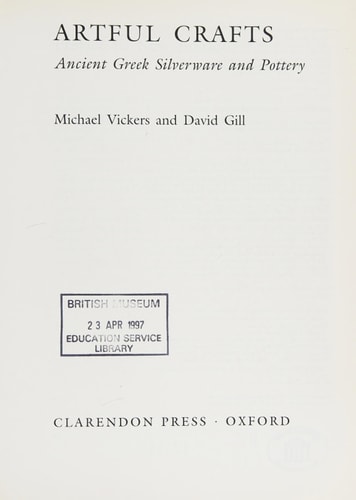
Artful Crafts: Ancient Greek Silverware and Pottery
0
0
As an Amazon Associate and affiliate partner, Menrva Books earns from qualifying purchases. Learn more
Author Description
Exciting and provocative in its argument, this book challenges the widely held view that Greek pottery vases were objects of great value in antiquity, commissioned by rich patrons from the greatest artists of the day. Instead, they are shown to have been simply low cost versions of tableware originally made in silver and gold. This book demonstrates how Greek pottery first came to be regarded as a high value commodity in the eighteenth century thanks to clever, if not fraudulent, sales techniques; it examines the primary sources, both literary and epigraphic, to find what materials the ancients did consider to be important; and it explores the ways in which work in gold and silver influenced painted pottery.
Menrva's Summary
THE THESIS
This book investigates the historical valuation of Greek pottery, challenging the conventional belief that these vessels were prized luxury items in antiquity. Authors David Gill and Michael Vickers, both established scholars in classical archaeology, utilize a combination of epigraphic evidence, literary sources, and material analysis to argue that painted pottery served as a low-cost substitute for more prestigious gold and silver tableware. They contend that the modern perception of Greek vases as high-value art objects is a construct originating in the eighteenth century, influenced by market practices and historical misinterpretations.
THE SCOPE MAP
What You Will Find
- Analysis of the economic and social status of pottery versus metalware in ancient Greek society.
- Examination of eighteenth-century art market practices and the origins of the high-value perception of Greek vases.
- Review of primary literary and epigraphic sources regarding ancient material values.
- Exploration of the stylistic influence of precious metalwork on the design and decoration of painted pottery.
THE AUTHORITY PERSPECTIVE
Experts frequently cite this work as a significant contribution to the field of classical archaeology for its provocative re-evaluation of material culture. Readers note the academic rigor of the text, which serves as a foundational challenge to traditional art historical narratives regarding ancient Greek ceramics.
Page Count:
272
Publication Date:
1995-01-26
Publisher:
Oxford University Press
ISBN-10:
0198132263
ISBN-13:
9780198132264
History
Pottery Greek
Vase Painting
Archaeology
Goldwork
Ancient Greece
Silverwork
Art History
Community Tags
Similar Books