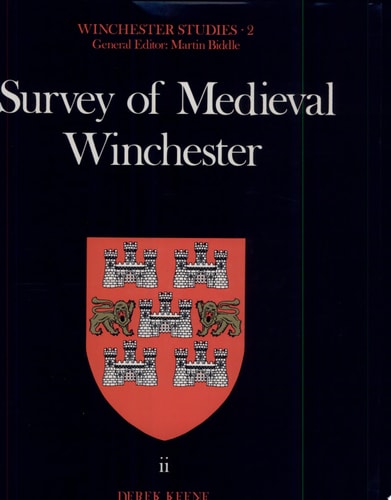
Survey of Medieval Winchester
0
0
As an Amazon Associate and affiliate partner, Menrva Books earns from qualifying purchases. Learn more
Author Description
By the fourteenth century Winchester had lost its former eminence, but in trades, manufactures, and population, as well as by virtue of its administrative and ecclesiastical role, the city was still one of the major provincial centres in England. This Survey is based on a reconstruction of the histories of the houses, plots, gardens, and fields in the city and suburbs between c. 1300 and c. 1540, although in many instances both earlier and later periods are also covered. The reconstruction takes the form of a gazetteer (Part ii) of 1,128 histories of properties, together with accounts of 56 parish churches and the international fair of St. Giles, all illustrated by detailed maps. There is also a biographical register (Part iii) concerning more than 8,000 property-holders, most of whom lived in Winchester. This is the first time that it has been possible to piece together such a precise and detailed picture of both the topography and the inhabitants of a medieval town. Part i of the book contains a full discussion of the significance of this material and, in a manner relevant to an understanding of life in medieval towns in general, describes and defines such matters as the evolution of the physical environment, housing, land-tenure, property values, the parochial structure, the practice and organization of trades, and the ways in which the citizens of Winchester adapted to the declining status of their city.
Menrva's Summary
THE THESIS
This work investigates the socio-economic and topographical evolution of Winchester between 1300 and 1540 to determine how a major provincial center adapted to shifting administrative and ecclesiastical roles. Derek J. Keene utilizes an extensive reconstruction of property histories, land-tenure records, and biographical data to provide a granular analysis of urban life. By synthesizing these diverse datasets, the author establishes a comprehensive framework for understanding the physical and social organization of a medieval English city during a period of economic transition.
THE SCOPE MAP
What You Will Find
- A detailed gazetteer documenting the histories of 1,128 individual properties, including houses, plots, and fields.
- A biographical register cataloging over 8,000 property-holders and citizens.
- Primary source analysis of 56 parish churches and the administrative records of the St. Giles fair.
- Methodological insights into the evolution of housing, land-tenure systems, and trade organization in medieval urban environments.
THE AUTHORITY PERSPECTIVE
Scholars and historians regard this survey as a foundational text for the study of medieval urban topography and social structure. Readers frequently note the immense density of the data, which serves as a primary reference for researchers examining the intersection of property ownership and civic development in England.
Page Count:
1500
Publication Date:
1985-03-28
Publisher:
Oxford University Press
ISBN-10:
019813181X
ISBN-13:
9780198131816
History
Urban History
Archaeology
British History
Reference
Community Tags
Similar Books