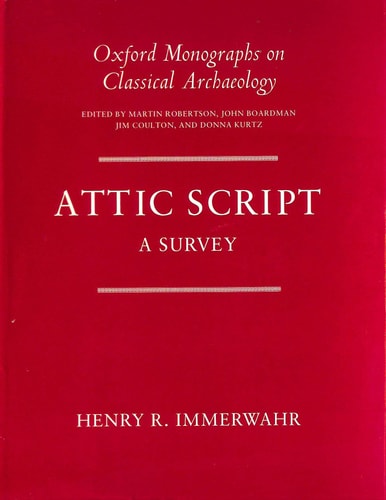
Attic Script: A Survey
0
0
As an Amazon Associate and affiliate partner, Menrva Books earns from qualifying purchases. Learn more
Author Description
This study places the inscriptions found on Athenian vases in the context of the early development of writing in Athens. Focusing on the period from the invention of the alphabet in the 8th century B.C. to the early 4th century B.C., when the local alphabet had been supplanted by the common Ionic script, the book presents inscriptions on stone, both public and private, scratched inscriptions on pottery, including the political ostraca, and some inscriptions on lead tablets. Although the vase inscriptions are brief, they number in the thousands and give an accurate picture of the art of writing and the state of literacy in the Classical Period.
Menrva's Summary
THE THESIS
This study investigates the evolution and social function of writing in Athens from the 8th century B.C. through the early 4th century B.C. Henry R. Immerwahr, a noted scholar of classical epigraphy, utilizes a vast corpus of physical evidence to trace the transition from local Athenian scripts to the standardized Ionic alphabet. By analyzing the intersection of public epigraphy and private pottery inscriptions, the author argues that these brief texts provide a comprehensive index of literacy and cultural development during the Classical Period.
THE SCOPE MAP
What You Will Find
- Analysis of inscriptions on Athenian pottery, stone monuments, and lead tablets.
- Examination of the transition from the local Athenian alphabet to the Ionic script.
- Evaluation of political ostraca as primary source material for literacy levels.
- Contextualization of writing practices within the broader development of Athenian art and society.
THE AUTHORITY PERSPECTIVE
Scholars and students of classical archaeology frequently cite this work as a foundational reference for understanding the epigraphic habits of the Athenian public. Readers often note the academic density of the prose, which serves as a rigorous technical resource for researchers in the field of ancient literacy.
Page Count:
286
Publication Date:
1990-07-12
Publisher:
Clarendon Press
ISBN-10:
0198132239
ISBN-13:
9780198132233
History
Ancient Greece
Linguistics
Archaeology
Community Tags
Similar Books