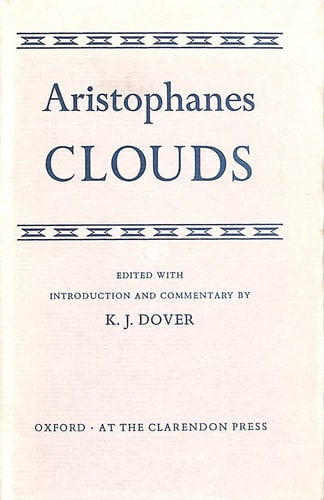
Clouds
0
0
As an Amazon Associate and affiliate partner, Menrva Books earns from qualifying purchases. Learn more
Author Description
Strepsiades attempts to enroll in Socrates's special school for sophists in order to learn the slippery, dishonest Unjust Argument that will help him get the better of his creditors in court. He learns many strange and wonderful things about atheism, natural sciences, and proper nouns. However, he proves an impossible pupil and thus decides to enroll his spend-thrift son Pheidippides instead. Pheidippides masters the slippery rhetoric of the Unjust Argument.
Menrva's Summary
THE PULSE
A desperate father attempts to manipulate the legal system by enrolling his son in a school of sophistry, triggering a series of chaotic and ironic consequences. Strepsiades seeks to escape his mounting debts by mastering the art of dishonest rhetoric, turning to the philosopher Socrates for instruction. The narrative follows his failed attempts at education and his subsequent decision to force his son, Pheidippides, into the school. The play utilizes a satirical framework to critique the intellectual trends of the era, presenting the conflict through dialogue-heavy scenes and choral commentary.
INSIDE THE PAGES
- Use of the Chorus to provide social commentary and moral framing
- Satirical portrayal of contemporary philosophical figures
- Exploration of the conflict between traditional values and new intellectualism
- Use of slapstick and physical comedy to underscore thematic absurdity
- Structural reliance on the agon, or formal debate, between opposing arguments
- Critique of the sophist movement and its perceived moral relativism
- Integration of mythological references to heighten the comedic irony
- Focus on the generational divide regarding education and ethics
THE COLLECTIVE ECHO
Discussion often centers on the play's role as a primary source for understanding the public perception of Socrates in ancient Athens. Readers frequently highlight the sharp contrast between the character of Socrates as depicted here and the more serious portrayals found in Platonic dialogues. The pacing is noted for its rapid shifts between philosophical debate and farcical domestic conflict. Critics often examine how the work functions as a critique of the intellectual climate of the time rather than a literal biographical account. The play remains a central text for those interested in the history of comedy and the evolution of satirical writing.
Page Count:
416
Publication Date:
1968-12-31
Publisher:
Oxford University Press
ISBN-10:
0198141742
ISBN-13:
9780198141747
Philosophy
Western
Religion
Drama
History
Satire
Comedy
Dramatic works
Classical
Community Tags
Other Editions(15)

Hackett Publishing
2014
Default edition
Literary Licensing, LLC
2014
Hackett Publishing
2013
CreateSpace Independent Publishing Platform
2013
CreateSpace Independent Publishing Platform
2013

CreateSpace Independent Publishing Platform
2011

CreateSpace Independent Publishing Platform
2011
Kessinger Publishing, LLC
2010

General Books LLC
2010

RicherResourcesPublications
2009
Kessinger Publishing, LLC
2004
Clarendon Press
1989
Bolchazy Carducci
1984
Oxford University Press
1968

Hakkert, A. M.
1911
Similar Books

Reader Comments
Share Your Thoughts
No comments yet. Be the first to share your thoughts!