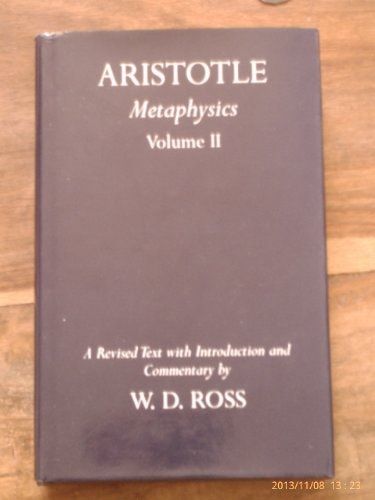
Aristotle's Metaphysics, Volume II: A Revised Text with Introduction and Commentary
0
0
As an Amazon Associate and affiliate partner, Menrva Books earns from qualifying purchases. Learn more
Author Description
"All men by nature are actuated with the desire of knowledge," declared Aristotle. The philosopher's works are foundational to the history of science, and his treatise on metaphysics, or "first philosophy," is divided into sections on previous philosophical thought and theories; a refutation of skepticism; a demonstration of God's existence; an examination of the relation of metaphysics to the other sciences; an elucidation of the nature of the infinite; and other major philosophical issues.The central theme consists of an inquiry into how substance may be defined as a category of being. Aristotle defines substance as ultimate reality, since substance belongs to no other category of being, and because substance serves as the basis for every other category of being. The philosopher also defines substance as an underlying reality, or as the substratum of all existing things. He describes substance as both formal and material reality, and he discusses the relation between potentiality and actuality. An excellent example of Aristotle's dialectical method, which reasons from reliable opinions rather than known truths, this work offers a fine introduction to classical metaphysics.
Menrva's Summary
THE THESIS
This work investigates the fundamental nature of being, substance, and reality through Aristotle's foundational inquiry into 'first philosophy'. W.D. Ross, a renowned classical scholar, provides a critical framework for this text by offering a revised translation alongside extensive commentary that contextualizes Aristotle's arguments within the broader scope of ancient Greek thought. The text systematically addresses the definitions of substance, the relationship between potentiality and actuality, and the logical structure of existence as a primary category of being.
THE SCOPE MAP
What You Will Find
- A comprehensive analysis of substance as the primary category of being and the substratum of reality.
- An examination of the dialectical method, which utilizes reliable opinions to approach philosophical truths.
- A detailed exploration of the relationship between formal and material reality.
- Scholarly commentary on the nature of the infinite and the existence of a primary mover.
THE AUTHORITY PERSPECTIVE
Scholars and students of philosophy widely regard this edition as a foundational resource for understanding Aristotelian metaphysics. Readers frequently note the academic density of the prose, which requires careful study to fully grasp the nuances of the dialectical arguments presented.
Page Count:
1070
Publication Date:
1997-01-01
Publisher:
Oxford University Press
ISBN-10:
0198141076
ISBN-13:
9780198141075
Philosophy
Metaphysics
Ancient History
Classical Philosophy
Community Tags
Similar Books